
What hormone tests are needed for gynecomastia?
Gynecomastia means enlargement of breast tissue in males. It usually happens when there is an imbalance between male hormones (testosterone) and female hormones (estrogen).
Before deciding on treatment, especially in adults with new, significant, or unexplained gynecomastia, a doctor may recommend some blood tests to find out why the breast tissue has enlarged.
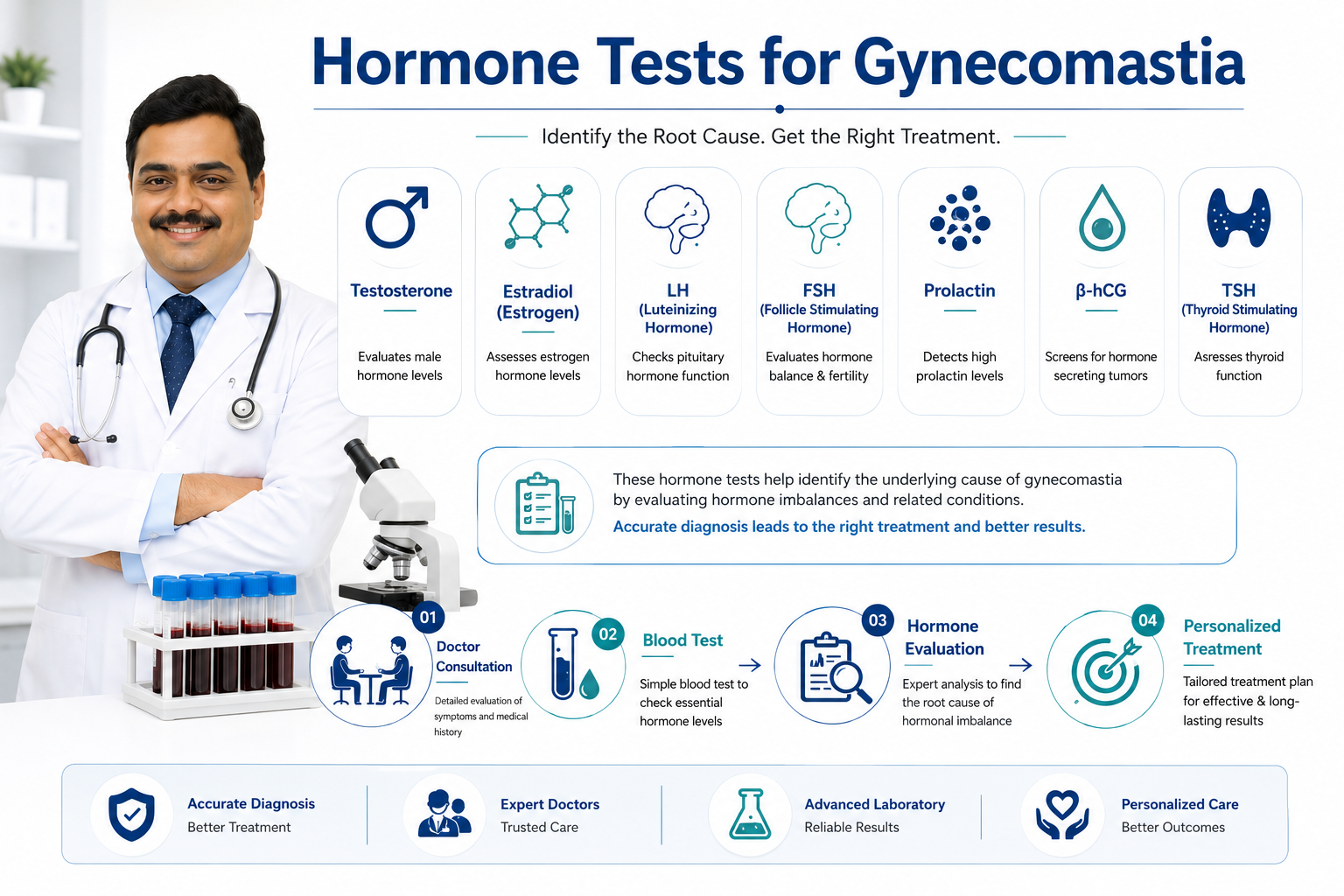
Which Hormone Tests Are Usually Done?
1. Testosterone
Test: Total Testosterone
Testosterone is the main male sex hormone. If testosterone is low, the balance between testosterone and estrogen can change and contribute to gynecomastia.
A morning testosterone test is generally preferred because testosterone levels change during the day.
2. Estradiol (Estrogen)
Test: Estradiol (E2)
Estrogen is normally present in men in small amounts. If estrogen activity becomes relatively high compared with testosterone, breast tissue can grow.
An increased estrogen level may occur with certain medications, obesity, liver problems, hormonal disorders, or, rarely, hormone-producing tumors.
Important: Gynecomastia does not always mean that the estrogen blood level will be high.
3. LH and FSH
Tests: LH and FSH
These hormones are produced by the brain and help control the testicles.
They are useful when testosterone is low because they help the doctor understand where the hormonal problem may be coming from.
For example, low testosterone with abnormal LH/FSH levels can suggest a problem involving the testicles or the hormone-control system.
4. Prolactin
Test: Prolactin
Prolactin is another hormone produced by the pituitary gland.
It is not the cause of most gynecomastia cases, but your doctor may check it when there are symptoms or other hormone abnormalities that suggest a possible pituitary or hormonal problem.
5. β-hCG
Test: Beta-hCG
This test is particularly important when gynecomastia develops suddenly, grows rapidly, or when the doctor finds something unusual during examination.
In some cases, an abnormal β-hCG level can be associated with a testicular or other hormone-producing tumor.
An abnormal result does not automatically mean cancer, but it needs proper medical evaluation.
6. Thyroid Test
Test: TSH
Thyroid problems, particularly an overactive thyroid, can sometimes be associated with gynecomastia.
A TSH test helps check whether the thyroid may be contributing to the condition.
Other Tests May Be Needed
Not every patient needs every test.
Depending on your age, symptoms, examination, medicines, and initial blood-test results, your doctor may also recommend:
- SHBG / Free Testosterone – if testosterone results are borderline or need further clarification
- Liver function tests – because liver disease can affect hormone metabolism
- Kidney function tests – because kidney disease can affect hormone balance
- AFP – in selected cases where a testicular tumor needs to be investigated
- Testicular ultrasound – if there is a lump, pain, abnormal examination, or suspicious hormone results
A Practical Basic Hormone Panel
For a patient with unexplained gynecomastia, a doctor may consider:
• Total Testosterone (morning)
• Estradiol (E2)
• LH
• FSH
• Prolactin
• β-hCG
• TSH
Additional tests are added when the patient's history or initial results suggest they are necessary.
Does Everyone With Gynecomastia Need Hormone Tests?
No. Hormone testing is not necessarily required for every case.
For example, gynecomastia during puberty is very common and often settles on its own. Similarly, a doctor may not order an extensive hormone panel when the history and examination clearly indicate a benign cause.
Testing becomes more important when gynecomastia:
- Develops suddenly or rapidly
- Is significant or persistent
- Occurs in adulthood without an obvious reason
- Is associated with low libido or sexual problems
- Is associated with testicular pain or a lump
- Occurs with other hormonal symptoms
- Is associated with medicines or supplements that may affect hormones
- Has unusual features on physical examination
Doctor’s Suggestion
Dr. Ashutosh Shah, M.B., M.S., M.Ch., D.N.B., Board-Certified Plastic Surgeon and Director of Elegance Clinic, recommends that gynecomastia should be evaluated individually before deciding on hormone therapy or surgery.
With more than 22 years of experience in plastic and cosmetic surgery, Dr. Shah emphasizes the importance of understanding the underlying cause of male breast enlargement before selecting a treatment approach.
Why Are These Tests Important Before Treatment?
The goal of hormone testing is not simply to find a high estrogen level.
The real goal is to identify whether there is an underlying cause that needs treatment.
If a hormonal or medical problem is found, treating that problem may be an important part of managing gynecomastia.
If the hormone evaluation is normal but the enlarged breast tissue remains, the treatment approach depends on factors such as how long the gynecomastia has been present, how much glandular tissue is present, symptoms, and the patient's cosmetic concerns.