
Medicines for Gynecomastia: Who They Help, For How Long, and When They Stop Working
Who can be treated with medicines for gynecomastia, and for how long? Medical treatment is most relevant when gynecomastia is relatively recent, particularly when breast tissue is tender or actively enlarging. Once glandular tissue has been present for a long time and becomes established, medicines are much less likely to reverse it. Treatment should therefore be based on symptom duration, examination and the underlying cause rather than simply trying tablets before surgery.
Hormonal therapy for gynecomastia is not appropriate for every enlarged male chest. Before considering a drug trial, the clinician needs to determine whether the enlargement is true glandular gynecomastia, predominantly fat, or a mixture of both.
The next question is why the gland developed. Medication-related changes, puberty, hormone abnormalities, anabolic steroid exposure, and certain medical conditions can all influence treatment decisions.
Why Does Medical Treatment Only Work in an Early Window?
Gynecomastia does not remain biologically identical throughout its course.
During an earlier, active phase, patients may notice:
- New nipple tenderness
- Sensitivity around the areola
- A recently developing lump
- Progressive breast enlargement
- A relatively recent change from their previous chest appearance
During this phase, glandular tissue may still be hormonally active.
As gynecomastia persists, the tissue can become increasingly established and fibrotic. At that stage, changing hormonal stimulation does not necessarily make the existing physical gland disappear.
This explains why a medicine that might be considered in a selected patient with recently developing, painful gynecomastia should not automatically be expected to flatten a firm gland that has existed for years.
The question is therefore not simply:
“Which medicine treats gynecomastia?”
It is:
“Is this particular gynecomastia still at a stage where medical treatment could reasonably help?”
Which Symptom Duration Still Qualifies for a Drug Trial?
There is no single duration cut-off that should be applied to every patient without clinical assessment.
In general, medical treatment is considered more relevant for recent-onset, symptomatic gynecomastia than for long-standing, stable enlargement.
The clinician will consider when the patient first noticed:
- Nipple pain
- Tenderness
- A firm lump
- Increasing nipple projection
- Progressive chest enlargement
A patient who developed tender breast enlargement relatively recently presents a different treatment situation from someone who has had a painless, unchanged gland since adolescence.
This is why patients should provide as accurate a timeline as possible.
For persistent disease, see Long-standing gynecomastia and medicine.
Why Does Tenderness Matter?
Tenderness can be useful because it may suggest that the condition is relatively active, particularly when it developed recently.
It is not, however, a guarantee that medicine will work.
Likewise, the absence of tenderness does not by itself prove that treatment is impossible.
Duration, physical examination, possible cause, and tissue characteristics all need to be considered together.
A firm, stable gland that has existed for years generally provides a very different treatment target from recently developing tender tissue.
Which Hormone Results Justify Starting Medicines?
A common misunderstanding is that every patient with gynecomastia needs a hormone tablet.
That is not the case.
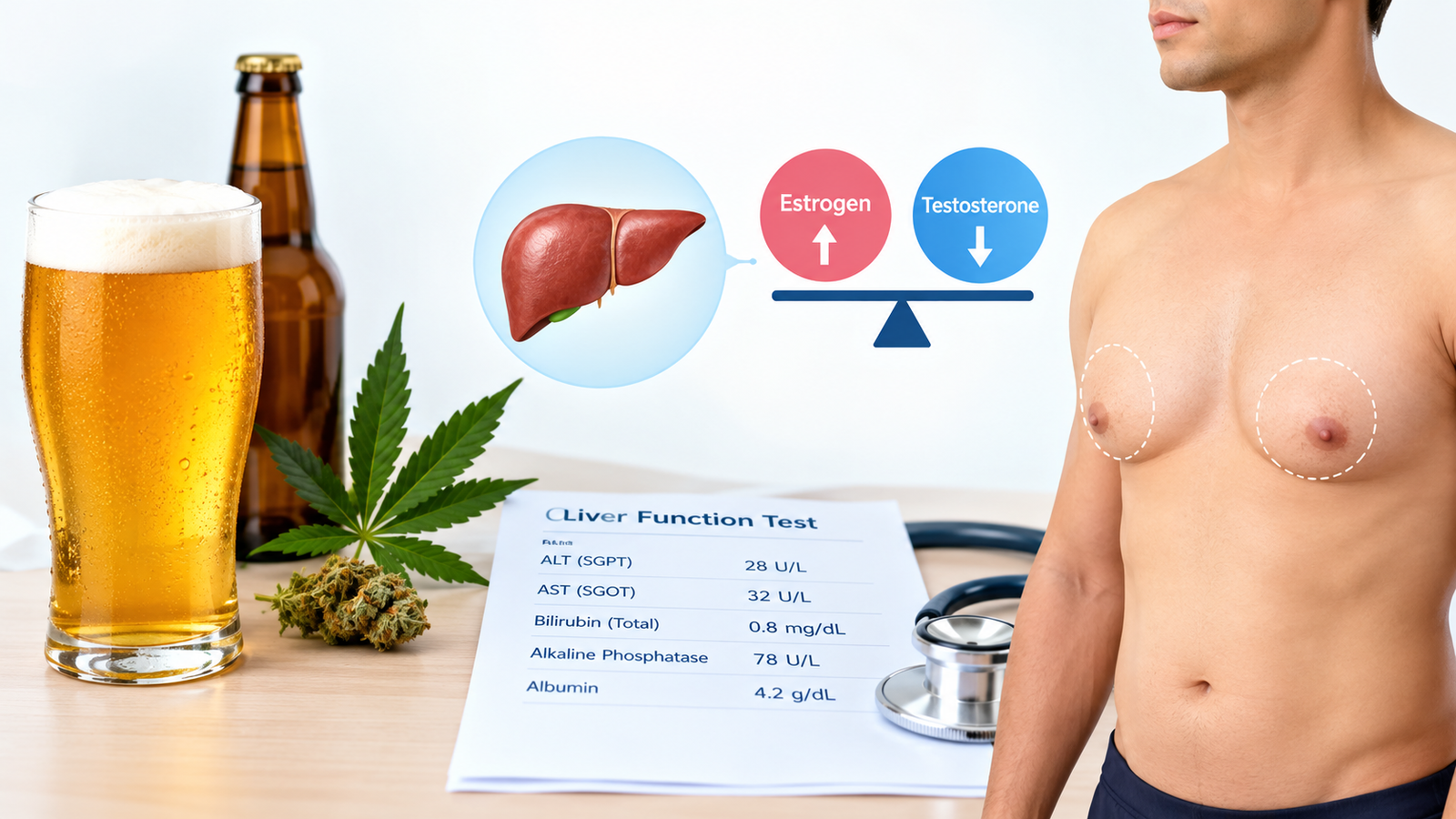
Laboratory investigations are used when the patient's history or examination suggests that an underlying hormonal or medical cause needs investigation. Tests should help identify the cause rather than serve as an automatic prescription for hormonal therapy.
Depending on the clinical situation, evaluation may include hormones related to testosterone, oestrogen, pituitary function, or other relevant systems, as well as investigations for underlying medical conditions when indicated.
An abnormal result does not automatically mean that a specific gynecomastia medicine should be started.
The clinician first needs to understand why the result is abnormal.
For a detailed explanation, read Hormone tests for gynecomastia.
What If All Hormone Tests Are Normal?
Normal hormone results do not automatically rule out gynecomastia.
A patient may have clinically apparent glandular enlargement without a currently detectable hormone abnormality.
The treatment decision can still depend on:
- Age
- Duration
- Tenderness
- Progression
- Medication history
- Previous anabolic steroid or hormone exposure
- Physical examination
- Amount of gland
- Stability of the condition
This is why blood-test results should not be interpreted separately from the clinical assessment.
Which Medicines May Be Considered?
Medical management of gynecomastia is specialist-directed. Different drugs act on different hormonal pathways and are not interchangeable.
Tamoxifen
Tamoxifen is a selective oestrogen receptor modulator (SERM). It has been used off-label in selected cases of gynecomastia, particularly when symptoms are relatively recent and painful.
It should not be treated as a general-purpose tablet for every man with an enlarged chest.
Whether it is appropriate depends on the patient's clinical circumstances, contraindications and potential risks.
Aromatase Inhibitors
Aromatase inhibitors reduce the conversion of androgens into oestrogens.
However, simply having gynecomastia does not mean that an aromatase inhibitor for male breast tissue is appropriate. Its role depends on the underlying clinical situation, and these medicines should not be self-prescribed.
Treatment of an Underlying Cause
Sometimes the most important "medical treatment" is not a gynecomastia-specific tablet at all.
Management may involve addressing an identified underlying cause, reviewing a potentially contributing medication with its prescriber, or treating a documented hormonal or medical disorder.
Drug Table: Medical Treatment at a Glance
| Medicine/approach | Who it may suit | Trial duration | Expected change | Main considerations/side effects |
|---|---|---|---|---|
| Tamoxifen (off-label) | Selected patients with relatively recent, symptomatic gynecomastia | Determined by treating clinician | May reduce tenderness and glandular enlargement in suitable early cases | Requires medical supervision; potential adverse effects and contraindications must be reviewed |
| Aromatase inhibitor | Selected situations where clinically appropriate | Individualized | Response depends heavily on cause and stage | Not routine treatment for every case; requires assessment and monitoring |
| Treatment of an underlying hormonal disorder | Patients with a confirmed underlying abnormality | Depends on diagnosis | Addresses the underlying driver; existing gland may not completely disappear | Requires cause-specific specialist management |
| Review/change of contributing medicine | When a prescribed medicine is suspected of contributing | Individualized | Recent enlargement may improve after an appropriate change | Never stop prescribed medication independently |
| Observation | Selected recent or physiologic cases where appropriate | Based on clinical follow-up | Some cases may improve without active drug treatment | Requires reassessment if enlargement progresses or concerning symptoms develop |
There is no universal drug course that should be copied from one patient to another.
How Long Does a Drug Trial Run Before It Is Called a Failure?
A drug trial for gynecomastia should have a defined purpose from the beginning.
The treating clinician should establish what improvement is being looked for, such as:
- Reduction in tenderness
- Reduction in gland size
- Stabilization of enlargement
- Improvement in symptoms
The duration depends on the drug, indication, and individual response.
Patients should not continue hormonal medicines indefinitely simply because they hope additional months will eventually eliminate established glandular tissue.
At review, the clinician should ask:
Has pain improved? Has the gland become smaller? Has enlargement stopped? Is the treatment causing adverse effects? Is there enough benefit to justify continuing?
If there is no meaningful response after an appropriate supervised trial, the diagnosis and treatment strategy should be reconsidered.
How Is Response Measured?
Photographs can help document visible changes, but appearance alone is not enough.
Clinical review may consider:
- Tenderness
- Palpable gland size
- Nipple projection
- Overall chest contour
- Symmetry
- Changes since the previous examination
Body weight should also be considered.
If a patient loses substantial body fat during treatment, the chest may look smaller even though the gland itself has changed very little.
That distinction matters when deciding whether medication genuinely worked.
Which Side Effects Must Be Monitored?
Hormonal medicines can have adverse effects and should be used only when there is a reasonable clinical indication.
The side-effect profile depends on the specific drug.
Tamoxifen, for example, has potential adverse effects and important contraindications that should be reviewed before treatment. Rare but potentially serious complications can occur, which is one reason it should not be purchased and taken without medical supervision.
Aromatase inhibitors have a different adverse-effect profile and are also not appropriate for unsupervised use.
Patients should tell their doctor about:
- Current medicines
- Previous medical conditions
- History of blood clots
- Liver problems
- Hormonal treatment
- Supplements
- Anabolic steroid use
- Previous adverse drug reactions
The prescribing clinician can then determine which monitoring, if any, is required.
Is Tamoxifen Approved Specifically for Gynecomastia?
Tamoxifen is widely known as a medicine used for hormone-sensitive breast cancer and certain other medical indications.
Its use for gynecomastia is generally considered off-label, meaning gynecomastia is not its primary approved indication, even though clinicians may use it in selected circumstances based on clinical evidence and judgment.
"Off-label" does not automatically mean inappropriate.
It does mean the reason for treatment, expected benefit, alternatives, limitations, and potential adverse effects should be discussed with the patient.
Patients should not self-medicate with tamoxifen after reading about it online.
Why Don't Medicines Work Well for Long-Standing Gynecomastia?
This is the most important limitation to understand.
Once glandular tissue has been present for a long time and becomes established or fibrotic, changing hormonal signals does not reliably remove the physical tissue that is already there.
Imagine the difference between preventing a process while it is active and trying to reverse a structural change after it has become established.
This is why long-standing gynecomastia should not automatically be subjected to repeated courses of medication.
The patient may experience side effects without obtaining the chest-contour improvement they actually want.
For more detail, see Long-standing gynecomastia and medicine.
What Happens When the Trial Fails?
A failed medical trial does not mean that treatment has reached a dead end.
Instead, the case should be reassessed.
The clinician should consider:
Was the diagnosis correct? Was the gland already established? Is there an ongoing hormonal or medication-related trigger? Is the remaining enlargement glandular tissue, fat, skin, or a combination?
If persistent glandular tissue is responsible for the remaining chest enlargement, surgery may become the more relevant treatment option.
Read When surgery is needed instead of medicine for the next step.
Why Repeating Different Medicines May Not Help
When the first medical treatment fails, patients sometimes assume that they simply need a stronger medicine or another hormonal drug.
That is not necessarily true.
If the main reason for failure is that the gland is already established, switching repeatedly between medicines does not change the fundamental problem.
The treatment target is now structural tissue rather than an early active hormonal process.
Before starting another drug, ask what evidence suggests that the second treatment is more likely to work.
Medical Treatment Versus Surgery
Medical treatment and surgery should not be viewed as competing versions of the same treatment.
They address different clinical situations.
Medical management is most relevant when there is a potentially treatable underlying cause or an appropriate early window in selected patients.
Surgery physically removes or contours established tissue when non-surgical management is unlikely to provide sufficient correction.
A patient with recently developing tender gynecomastia may therefore receive very different advice from a patient with a firm, painless gland that has been unchanged for several years.
At Elegance Clinic, Surat, assessment can include the duration of symptoms, characteristics of the gland, medication history, and relevant investigations before discussing whether a medical trial or surgical evaluation is appropriate.
Why Evaluation Before Treatment Matters
Starting hormonal medication without first understanding the cause can create two problems.
First, the patient may take a medicine that is unlikely to help.
Second, an underlying reason for the breast enlargement may be missed.
Dr. Ashutosh Shah, with 22+ years of experience in plastic and cosmetic surgery, evaluates the clinical history and physical characteristics of gynecomastia before determining whether conservative management, further medical investigation, or surgical correction should be considered.
For additional background, see the Hormonal therapy information page.
Conclusion
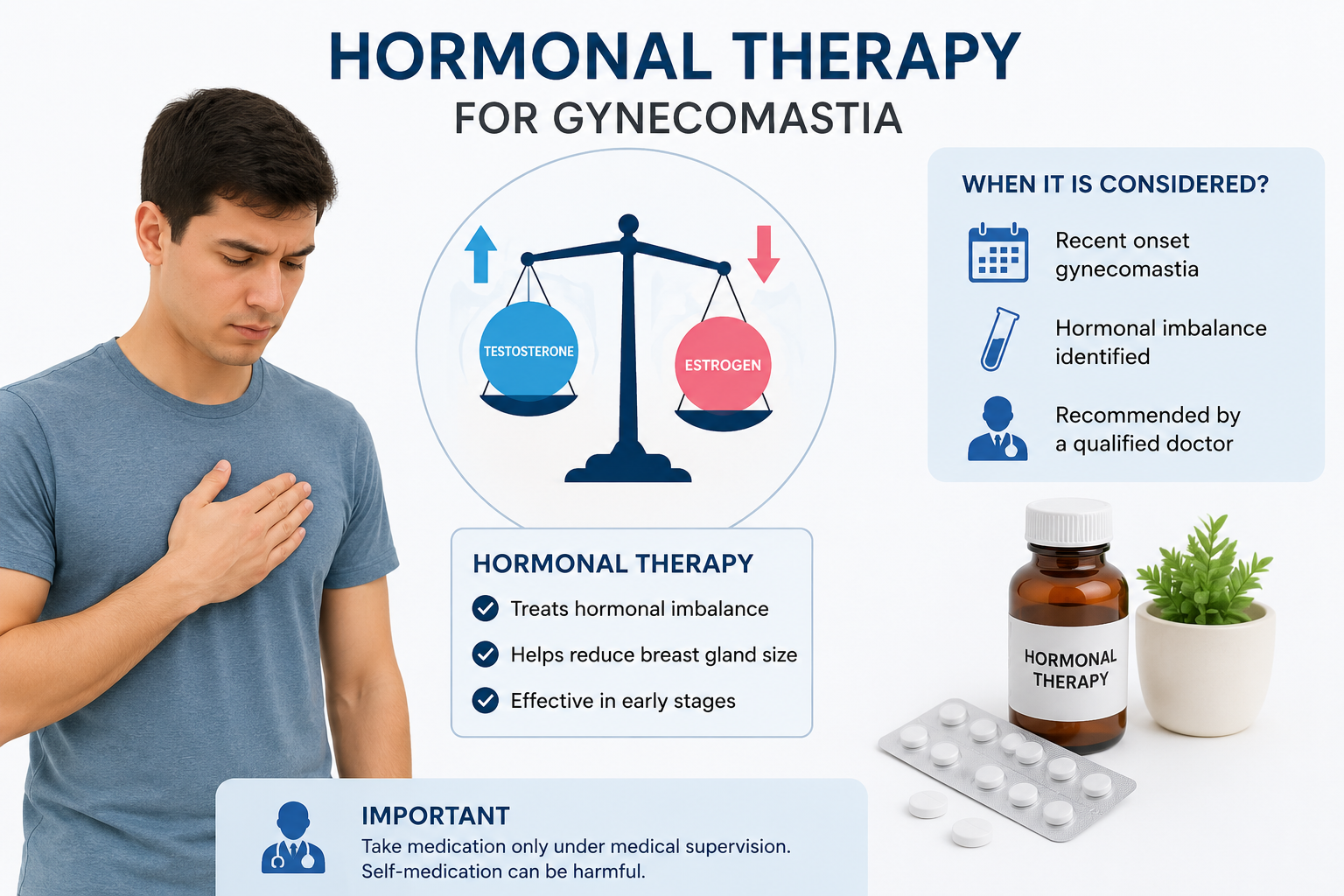
Hormonal therapy for gynecomastia is not a universal alternative to surgery. Its usefulness depends heavily on who is being treated and when treatment begins.
Recent, symptomatic or actively developing gynecomastia may provide an opportunity for medical management in appropriately selected patients, particularly when an underlying cause can be identified and addressed.
Long-standing, stable, and established glandular tissue is different. Once structural glandular tissue has persisted, medication becomes much less likely to produce the physical reduction a patient expects.
Before starting treatment, establish the diagnosis, duration, possible cause, and treatment goal. If a supervised drug trial is appropriate, it should have a clear review point and safety monitoring.
If the trial does not produce meaningful improvement, continuing medication indefinitely is not necessarily the answer. Reassessment can determine whether persistent glandular tissue now requires a different treatment approach.