

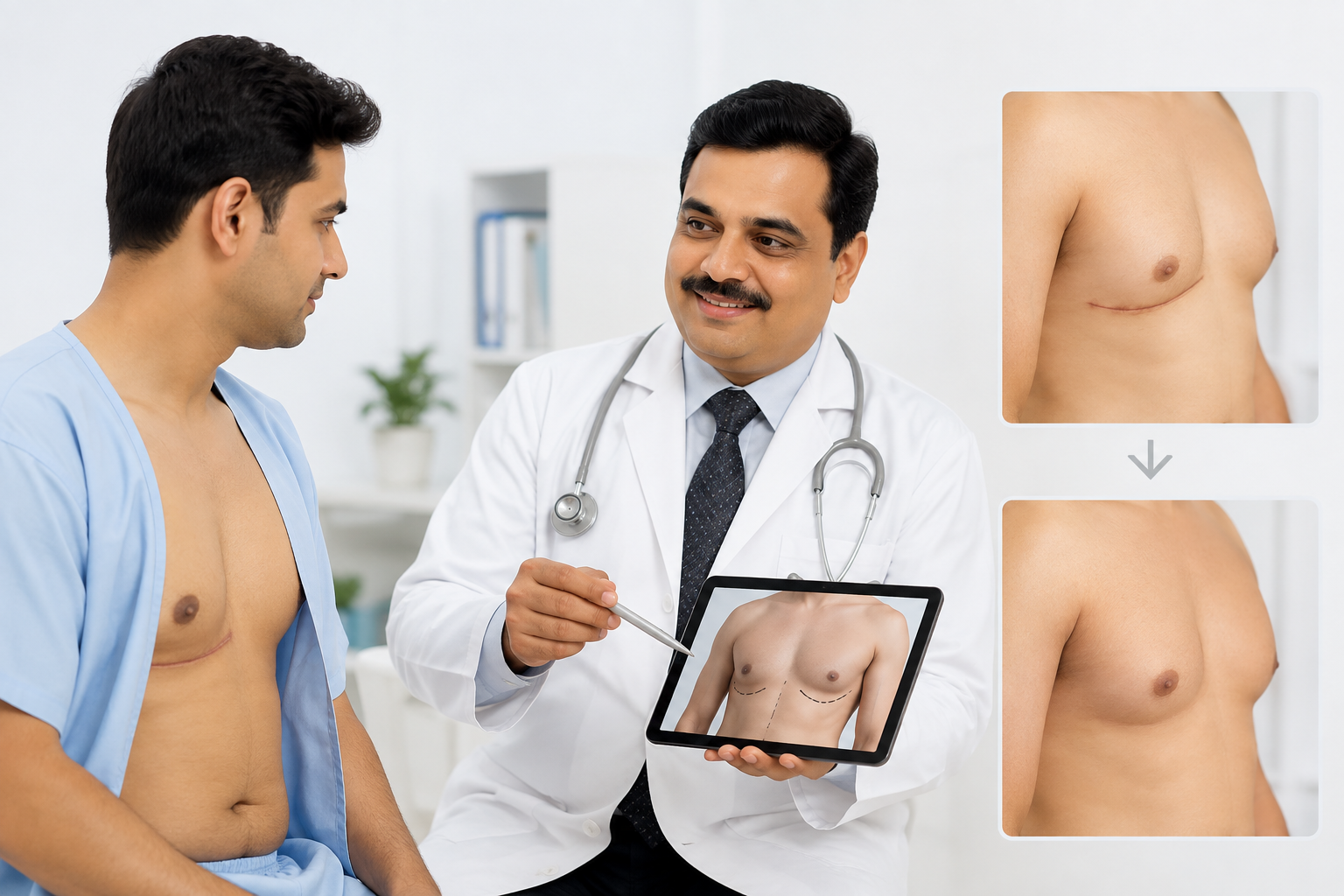
Gynecomastia Scar at 3, 6 and 12 Months: What Is Normal and When Revision Helps
A gynecomastia scar may remain pink, brown, darker, or slightly firm at three months, then gradually soften and fade. Healing varies, and scars can change beyond a year. Progressive thickening, growth outside the incision, or troublesome symptoms deserve assessment. Silicone may help selected scars; surgical revision is usually considered after maturation.
What Does the Gynecomastia Scar Healing Timeline Really Mean?
A closed incision is not a fully matured scar. After the skin heals, the scar continues to remodel, changing in colour, firmness and texture.
The NHS explains that scars can take two years or longer to fade. Therefore, twelve months is a useful review point rather than a guarantee that every scar has reached its final appearance.
Scar appearance also depends on the operation. Small liposuction entry scars differ from an incision near the areola or a longer line used for skin removal.
Compare your progress with earlier photographs of your own scar rather than expecting it to match another patient’s healing.
What Is Normal at 3, 6 and 12 Months?
The table below provides a practical guide. These stages overlap, and skin colour, wound healing and individual scar tendency affect the appearance.
| Time since surgery | Appearance that may occur | Changes needing review | What to do |
|---|---|---|---|
| First few weeks | A healing incision with temporary colour change and tenderness | Wound opening, discharge, increasing heat or worsening pain | Follow wound-care instructions and report concerning changes |
| Around 3 months | A visible line that may remain pink, reddish, brown, darker or firm | Progressive thickening, increasing itch or growth beyond the incision | Arrange assessment; discuss silicone once fully healed |
| Around 6 months | Gradual softening, flattening or fading in some patients | Continued enlargement, troublesome pain or pulling | Review the scar type and response to treatment |
| Around 12 months | A more settled scar, although colour and texture may still change | Persistent widening, puckering, tethering or a growing raised scar | Discuss whether continued care or revision fits the problem |
| Beyond 12 months | Further maturation is possible | Ongoing symptoms or an unsatisfactory stable scar | Reassess treatment options and realistic benefits |
The trend matters more than the month alone. A scar that is gradually softening raises different questions from one that is becoming thicker and spreading.
What Should a Scar Look Like at Three Months?
At three months, the scar may still be noticeable. Some firmness or a colour difference does not automatically mean the operation has healed badly.
However, “it is still early” should not be used to dismiss progressive thickening. The American Academy of Dermatology advises contacting a dermatologist if a surgical scar starts thickening, particularly when there is a history of keloids.
Take occasional photographs in similar lighting if your clinician recommends this. Record changes in symptoms as well as appearance.
Should the Scar Have Faded by Six Months?
Some improvement may be visible by six months, but the amount varies.
A flat scar that remains darker than the surrounding skin is different from a raised scar that continues to enlarge. Colour alone does not establish a keloid diagnosis, and not every dark scar needs injections.
If you are concerned about a chest scar problem, ask the clinician to identify the specific issue:
- Pigmentation.
- Excess scar thickness.
- Widening.
- Skin tethering.
- A contour depression beneath the scar.
These problems do not all respond to the same treatment.
Is Twelve Months the Right Time for Scar Revision?
It can be an appropriate time to discuss surgical revision if the scar has stabilised and remains troublesome.
ASPS describes allowing around a year, or longer after delayed healing, before assessing some scars for surgical revision. The decision remains individual.
You do not need to wait a year to seek advice or start suitable nonsurgical care. Earlier assessment may help manage a developing raised scar.
Equally, reaching twelve months does not automatically make another operation worthwhile. The surgeon should explain what can improve and why surgery offers an advantage over continued treatment.
How Do Hypertrophic Scars and Keloids Differ?
Both are raised scars, but their growth patterns differ.
A hypertrophic scar stays within the original wound boundaries. It may become less noticeable over time.
A keloid extends beyond the original injury and may continue growing for months or years. The AAD highlights this distinction when explaining raised scars.
Possible reasons to arrange review include:
- A scar becoming progressively thicker.
- Growth beyond the incision line.
- Persistent itch, pain, or sensitivity.
- Pulling that distorts nearby skin.
- Symptoms interfering with clothing or daily activities.
Tell the clinician about raised scars after earlier operations, acne, vaccinations, injuries, or piercings. Family history also helps inform the assessment.
Which Nonsurgical Treatments Are Tried First?
Treatment should match the scar’s characteristics. A flat pigmented line, a thick raised scar, and a puckered incision require different discussions.
Silicone gel or sheets
Silicone is a commonly recommended first-line, non-invasive option for preventing and managing raised scars. Published practical scar-management guidelines support silicone-based gels and sheets as part of scar care.
For silicone gel for chest scar care, ask your surgeon to confirm that the wound is fully closed and ready.
Do not apply silicone over an open wound or a scab. Consistent use may be needed for months, and irritation or a rash should be reported.
Silicone cannot erase a scar or correct every widened or tethered incision.
Corticosteroid injections
A clinician may recommend injections for selected hypertrophic scars or keloids. The aim is to reduce excessive scar activity, thickness, and symptoms.
International scar-management recommendations identify silicone and intralesional corticosteroids as important treatments for abnormal scars. Updated recommendations also discuss combination approaches for selected cases.
Injections need careful dosing and placement. Possible effects include skin thinning, an indentation, visible small blood vessels, and lighter or darker patches. These risks are described in NHS patient guidance.
They should not be used automatically for a flat dark scar.
Laser treatment
Selected lasers may help particular scar features, such as redness or texture. Suitability depends on scar maturity, skin characteristics and treatment goals.
Ask what the laser is intended to improve and about pigment-change risks. A treatment offered for redness may not correct a stretched scar or underlying contour problem.
Pressure and other support
Pressure therapy may be included in selected scar plans, but an ordinary postoperative vest is not automatically a prescribed scar-pressure treatment.
Do not tighten a garment excessively or add padding without guidance. The fit, location and duration should be explained by the treating team.
Does Sun Exposure Darken Chest Scars?
Sun exposure can make colour differences more noticeable. Protect healing scars when outdoors rather than relying on fading alone.
NHS guidance recommends covering scars in sunlight for at least a year and using sunscreen with SPF 30 or higher. Apply products only when the wound is sufficiently healed, and your clinician agrees.
Avoid using strong bleaching products, acids, or home remedies on a healing incision without medical advice.
Follow the clinic’s Post-operative guidelines alongside your individual discharge instructions.
When Is Surgical Scar Revision Worthwhile?
Scar revision after gynecomastia may be considered for a stable scar that is widened, puckered, tethered, or poorly positioned, where a specific surgical change could improve it.
Revision usually replaces the existing scar with a new one designed to heal more favourably. It does not remove your tendency to scar.
ASPS describes scar revision as an attempt to make a scar less conspicuous and better blended with surrounding skin. Complete removal is not the expected outcome.
For further reading, see the Chest scar revision guide, What scar revision surgery involves, and Scar revision in gynecomastia.
Can a Keloid Return After Removal?
Yes. A keloid after gynecomastia surgery needs a recurrence-prevention discussion before excision is considered.
The AAD warns that keloids frequently return after surgery alone. Clinicians may combine removal with other treatments to reduce that risk.
Ask what follow-up and additional treatment would be planned. A promise to simply “cut it out permanently” does not explain the central challenge.
What Should You Ask About gynecomastia scar treatment in Indore?
Ask for a diagnosis of the scar type and a clear explanation of the treatment goal. Clarify whether the concern is colour, thickness, width, tethering, or a deeper contour change.
During an assessment with Dr. Ashutosh Shah at Elegance Clinic, bring dated photographs and details of previous scar treatments. Discuss your healing history and ask what improvement is realistic before choosing injections, laser, or revision.
A useful plan should explain treatment duration, possible side effects, follow-up, and the chance of needing additional care.
Book a consultation if your scar is thickening, symptomatic, or remains a concern.