
Can Diet Reduce Gynecomastia? What Weight Loss Changes and What It Never Will
Can diet reduce gynecomastia? It can help reduce excess chest fat, especially when weight gain is contributing to a fuller chest. However, diet and weight loss cannot directly remove true gynecomastia caused by enlarged glandular breast tissue. This distinction is important because many men spend months trying to flatten the chest through dieting and exercise when the remaining fullness is actually firm glandular tissue.
At Elegance Clinic, Dr. Ashutosh Shah assesses whether chest enlargement is mainly fat, glandular tissue, or a combination of both before recommending treatment. This helps avoid unnecessary treatment and gives patients a more realistic idea of what weight loss can achieve.
What Does Weight Loss Actually Change in the Male Chest?
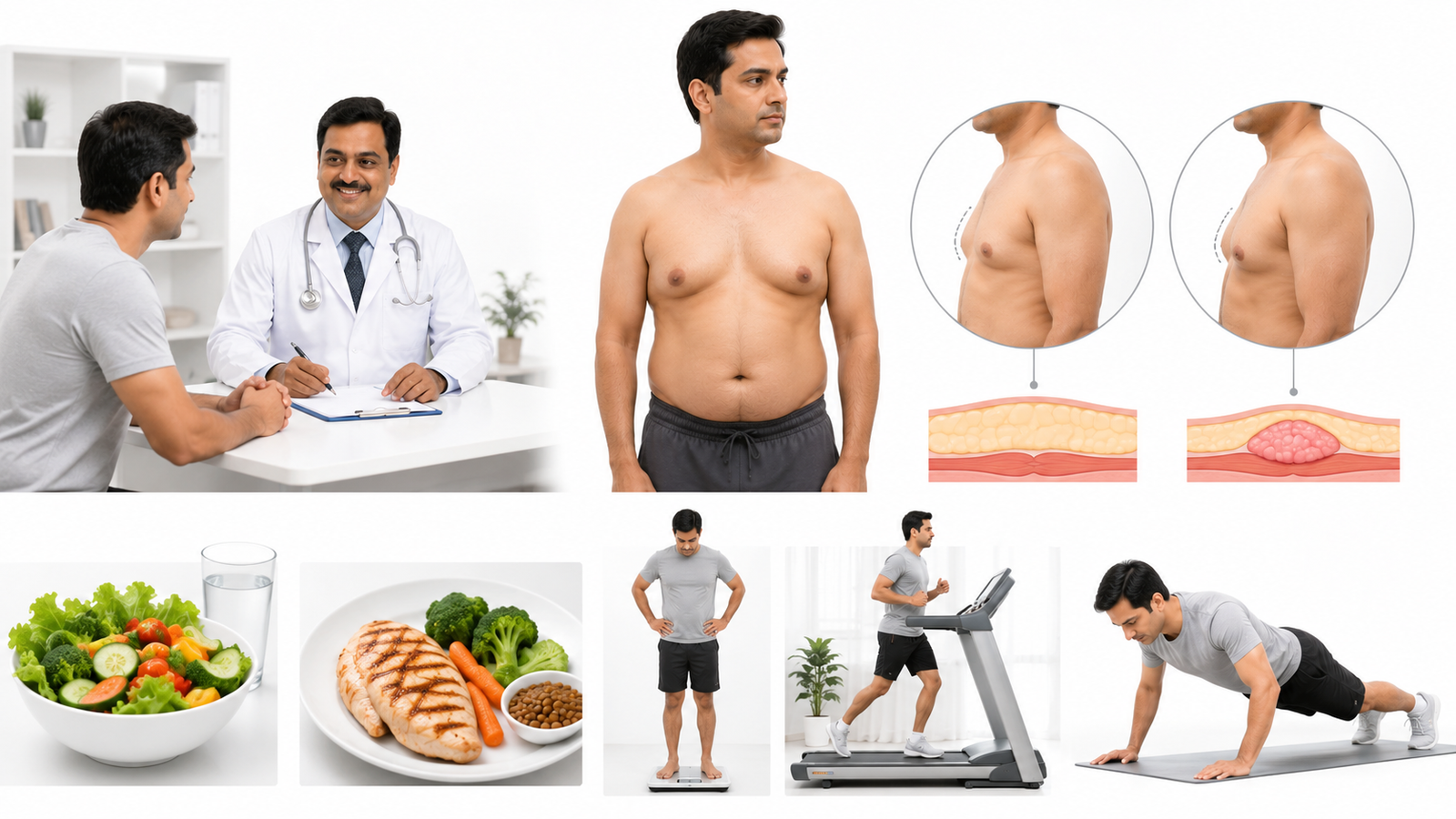
When a man loses body fat, the chest can become flatter and more defined. This is particularly noticeable when the chest enlargement is mainly caused by excess fat, sometimes called pseudogynecomastia.
For example, a man who gains weight may develop a softer, more diffuse chest enlargement. As overall body fat decreases, some of this chest fullness usually decreases as well.
However, true gynecomastia is different. It involves enlargement of glandular tissue beneath the nipple and areola. This tissue often feels firmer and more concentrated than ordinary fat.
Therefore, losing weight may improve the appearance around the gland without completely removing the firm tissue underneath.
Why Can Diet Not Remove Glandular Gynecomastia?
Diet works by helping the body use stored energy and reduce body fat. It does not selectively dissolve breast gland tissue.
This is why a man can become significantly leaner but still notice a small firm area behind the nipple.
The chest may look better overall because surrounding fat has decreased. Yet the central gland can remain visible, particularly when the nipple projects forward.
This does not mean that dieting has failed. It simply means that the remaining chest enlargement may not be caused by fat alone.
Fat Versus Gland: What Does the Chest Feel Like?
One of the simplest ways to understand the difference is to notice how the tissue feels.
Chest fat is generally soft and spread out. It may blend gradually into the surrounding chest and can often be pinched between the fingers.
Glandular tissue is usually firmer and more concentrated. A firm or rubbery disc may be felt directly beneath the nipple or areola.
However, a self-examination is only a rough guide. Different types of tissue can overlap, and the chest can also contain fibrous tissue or postoperative changes.
For a more detailed explanation, see how to tell if male breast enlargement is fat or gland tissue.
How Does the Pinch Versus Firm Disc Test Work?
A simple self-check can help you understand what may be contributing to your chest appearance.
First, gently pinch the tissue around the chest rather than pressing aggressively. Soft tissue that feels diffuse and moves easily with the skin is more suggestive of fat.
Next, pay attention to the area directly underneath the nipple. A firm, rubbery, or disc-like area concentrated behind the nipple can suggest glandular tissue.
Still, this should not be treated as a diagnosis.
The amount of glandular tissue can vary, and some men have both fat and glandular enlargement. A clinical examination is more reliable when deciding whether weight loss alone is likely to produce the desired change.
Can Exercise Remove Glandular Gynecomastia?
Exercise can help reduce overall body fat and improve the appearance of the chest muscles. Strength training can also make the chest look more defined.
However, exercise does not directly remove an established gland.
A man may therefore become leaner and stronger while still noticing a firm area beneath the nipple.
You can read more about this distinction in can exercise and weight loss remove glandular gynecomastia.
This is also why increasing chest exercises alone does not always solve the problem.
Do Specific Foods Reduce Male Chest Fat?
There is no specific food that selectively removes gynecomastia or targets fat only from the male chest.
A balanced diet can support healthy weight loss, but the body determines where fat is lost first and where it is lost last.
A practical diet generally focuses on appropriate portions, adequate protein, vegetables, fruits, whole grains or other suitable carbohydrate sources, and limiting excessive high-calorie foods.
It is better to focus on sustainable weight management rather than looking for a single food that claims to eliminate male breast enlargement.
For additional information, see diet in gynecomastia.
What Weight Loss Result Is Realistic Over Six Months?
There is no single amount of weight loss that guarantees a specific chest result.
The visible change depends on starting weight, body fat distribution, genetics, age, skin quality, the amount of glandular tissue present, and how much weight is lost.
| Starting finding | Realistic change with weight loss | What may remain | Next step |
|---|---|---|---|
| Mainly chest fat | Chest size may decrease noticeably | Some residual fat or loose skin | Continue healthy weight management |
| Fat with mild glandular tissue | Overall fullness can improve | Firm tissue behind the nipple | Clinical assessment if persistent |
| Predominantly glandular tissue | Limited change from dieting alone | Firm central fullness | Discuss treatment options |
| Major weight loss with loose skin | Fat may reduce substantially | Loose or excess skin | Assessment after weight stabilises |
The goal should not be to lose as much weight as possible simply to test whether the chest will disappear.
Instead, reaching a healthy and sustainable weight can make the underlying chest structure easier to assess.
What Happens After Major Weight Loss?
Significant weight loss can change the chest considerably. As fat decreases, the chest may become smaller, but the skin may not tighten completely.
Some men may therefore notice loose skin or a remaining central fullness after reaching a stable weight.
This is another reason to assess the chest after weight has stabilised rather than assuming that every remaining bulge represents persistent gynecomastia.
In some cases, the remaining concern is mostly excess skin or fat. In others, glandular tissue remains the main issue.
When Should You Stop Trying Diet Alone?
If you have reached a healthy, stable weight and still have a firm enlargement beneath the nipple, further weight loss may not remove it.
This is particularly relevant when:
- The chest remains firm despite significant weight loss.
- The nipple continues to project forward.
- A concentrated disc-like area can be felt behind the nipple.
- The chest remains enlarged even when overall body fat is relatively low.
- The appearance causes ongoing concern despite maintaining a healthy weight.
At this point, a clinical assessment can help determine whether the remaining tissue is fat, gland, skin, or a combination.
When Does Surgery Become an Option?
Surgery is not automatically required simply because gynecomastia is present.
The decision depends on the cause of enlargement, the amount of glandular tissue, the amount of fat, skin quality, symptoms, and the patient's goals.
If the enlargement is primarily fat-related, weight management may be sufficient.
If significant glandular tissue remains after appropriate weight management, surgery may be discussed. Depending on the individual anatomy, treatment can involve removal of glandular tissue, liposuction, or a combination.
You can also read when gynecomastia needs surgery instead of medicine to understand when surgical treatment may be considered.
Why Getting the Diagnosis Right Matters
Trying to treat every enlarged male chest as a weight problem can lead to frustration.
Likewise, assuming every enlarged chest requires surgery can lead to unnecessary treatment.
The first step is understanding what is actually causing the fullness.
At Elegance Clinic, Dr. Ashutosh Shah evaluates the chest clinically and considers the patient's weight, history, tissue characteristics, and overall pattern of enlargement before discussing treatment.
This approach helps separate situations where lifestyle changes may be enough from those where glandular tissue is likely to remain.
Can Losing Weight Flatten the Chest Completely?
Sometimes, yes, particularly when the enlargement is primarily caused by excess fat.
However, if true glandular gynecomastia is present, weight loss may reduce the surrounding fat while leaving the gland behind.
Therefore, the result depends on the underlying cause rather than the number on the weighing scale alone.