

Gynecomastia Surgery Types: Liposuction, Excision or Both
The main gynecomastia surgery types are liposuction, gland excision, and a combination of both. Liposuction treats excess fat, while excision removes firm glandular tissue. Significant loose skin may need separate removal, sometimes with nipple repositioning. The appropriate operation depends on your tissue, skin quality, and goals rather than a machine name.
Why Are There Different Gynecomastia Surgery Types?
Male chest enlargement does not have the same composition in every patient.
Some chests contain mainly fat. Others have a firm gland beneath the nipple, while many contain both. Larger chests or those affected by major weight loss may also have excess skin.
A procedure that reduces fat may leave a prominent gland behind. Likewise, removing tissue without addressing substantial loose skin may leave a hanging fold.
Before discussing an operation, the surgeon needs to identify what contributes to your chest shape. Read the fat-versus-gland guide for background.
Gynecomastia Surgery Types Compared
| Surgical approach | Main tissue treated | When it may suit | Main limitation |
|---|---|---|---|
| Liposuction alone | Excess fat | Predominantly fatty fullness with suitable skin elasticity | May leave firm gland or loose skin |
| Gland excision alone | Firm breast gland | Localised glandular enlargement with little surrounding fat | May not address wider fatty fullness |
| Liposuction with gland excision | Fat and gland | Mixed enlargement requiring tissue removal and contour blending | Does not automatically correct substantial excess skin |
| Reduction with skin excision | Excess skin, with fat or gland removal as needed | Significant sagging or a hanging fold | Requires additional or longer scars |
| Reduction with nipple repositioning | Tissue excess and low nipple position | Selected larger or more drooping chests | Adds blood-supply, healing and sensation considerations |
ASPS describes liposuction, excision and combined treatment as established approaches. The selection depends on whether fat, gland, skin, or nipple position needs correction.
What Does Liposuction Alone Involve?
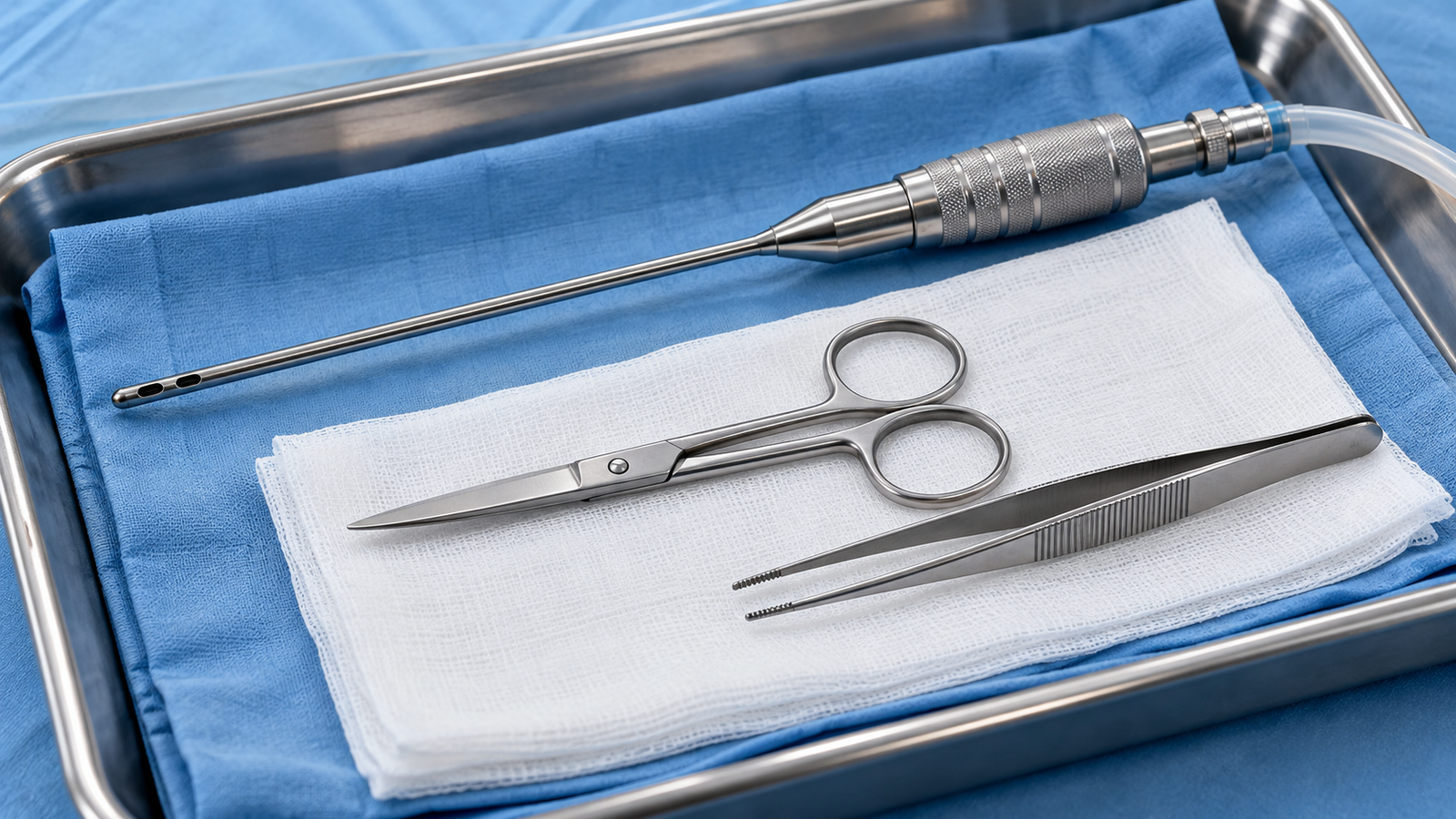
Liposuction removes fat through a thin hollow tube called a cannula, introduced through small skin openings.
It can reduce fatty fullness and help shape the chest. However, it does not reliably remove every firm glandular component, and it does not cut away redundant skin.
Liposuction alone may be reasonable when the examination shows mainly fat, and the skin is expected to fit the smaller contour adequately.
Ask the surgeon:
- Is there a firm gland beneath my nipple?
- What fullness could remain after liposuction?
- How much skin retraction is realistic?
- Could another procedure be needed later?
Small entry incisions do not mean scar-free surgery. Their position and appearance should still be discussed.
What Is Gland Excision?
Gland excision means surgically removing firm breast tissue.
A common approach uses an incision along part of the lower areola border. Other access techniques exist, and the incision depends on the tissue, anatomy, and surgical plan.
The Aesthetic Society explains that firm breast tissue commonly requires an incision beneath the areola, while areola reduction may require a circular incision around it.
Excision alone may suit selected patients whose enlargement is concentrated beneath the nipple with little surrounding fat.
The aim is an appropriate contour. Removing more tissue is not automatically better: the plan must consider the support beneath the nipple and the transition to the surrounding chest.
Why Are Liposuction and Excision Often Combined?
A chest may need both central gland removal and reduction of surrounding fat.
Combining the techniques allows the surgeon to address different tissues within the same operation. Liposuction can help blend the wider contour, while excision addresses glandular fullness.
Published comparisons support tailoring treatment rather than assuming one method is superior for every patient. A comparative study of liposuction alone and liposuction with gland excision reported comparable cosmetic outcomes in its study groups, reinforcing the importance of patient selection.
The relevant question is: “Which components of my enlargement will this operation treat?”
A combined procedure still needs a separate decision about loose skin.
When Does Male Breast Reduction Surgery Need Skin Removal?
Skin removal becomes a consideration when the skin envelope is too large to fit the reduced chest adequately.
The surgeon assesses:
- The amount and distribution of loose skin.
- Skin elasticity.
- A persistent hanging fold.
- Nipple position.
- The extent of tissue reduction.
- Your acceptance of additional scars.
Severe gynecomastia can require skin resection and nipple repositioning. These are recognised extensions of male breast reduction surgery, rather than procedures needed by everyone.
Some patients may be offered a staged approach, allowing the initial result to settle before deciding whether further skin correction is worthwhile.
For more information, see Loose chest skin in men.
What Does Nipple Repositioning Mean?
When the nipple sits low on a substantially enlarged or sagging chest, reducing volume alone may not place it appropriately.
In selected operations, the nipple and areola are moved while remaining attached to tissue that supplies blood. In more extensive cases, a free nipple graft may be discussed: the nipple–areola complex is detached and transferred to a new position.
A published surgical review describes both approaches for severe gynecomastia. The choice requires assessment of anatomy and blood supply; a grading label alone cannot determine it.
Ask specifically about healing, pigmentation, nipple projection, and sensation. A free graft has different trade-offs from moving the nipple on its blood supply.
Are VASER and Power-Assisted Liposuction Separate Operations?
VASER, power-assisted liposuction, and standard suction-assisted liposuction describe technologies used during fat removal.
They do not, by themselves, tell you whether gland excision or skin removal is included.
For example, a published VASER study explicitly combined the technology with gland excision. It therefore should not be used as evidence that a VASER-only procedure eliminates the need for gland removal.
Ask for the complete procedure name and tissue plan, rather than choosing solely from a device advertisement.
Read VASER versus standard liposuction for gynecomastia.
How Do Scars Differ Between Techniques?
Liposuction usually leaves small entry scars. Gland removal commonly adds a scar near the areola border.
Skin reduction can require a circular areola scar, a longer chest-fold scar or another pattern suited to the excess. Larger reductions may therefore leave substantially more scarring than limited gland removal.
Incisions are permanent, although they often become less noticeable. The Aesthetic Society emphasises that scar patterns vary with breast size, skin elasticity and the chosen procedure.
Request a drawing of your planned incisions. The scarless gynecomastia surgery guide explains why concealed incisions still leave scars.
Does the Surgical Method Change Anaesthesia and Recovery?
Yes, but the technique name alone does not determine the anaesthetic.
The amount of treatment, operating time, health conditions, and patient comfort all influence the plan. Local anaesthesia may suit selected procedures; sedation or general anaesthesia may be recommended for others.
Recovery also depends on the operation’s extent. Skin excision or grafting can add wound-care requirements. Across procedures, possible complications include bleeding, infection, wound-healing problems, asymmetry, noticeable scars and altered nipple sensation.
Ask for instructions specific to your procedure, including compression, work, lifting and exercise.
The chest may look smaller early, but swelling can obscure the contour. ASPS gives approximately three to six months as a general range for final results to develop.
How Should You Choose Between the Options?
Choose after an examination and a clear explanation of the expected benefits and limitations.
During a consultation with Dr. Ashutosh Shah at Elegance Clinic, ask how much of your enlargement comes from fat, gland, and skin, and how the proposed procedure addresses each component.
Useful questions include:
- Why does this approach suit my chest?
- What could remain untreated?
- Where will the scars sit?
- Is skin removal necessary now or potentially later?
- What complications should I understand?
- What is included in the quote and follow-up?
Surgery should follow an appropriate assessment of the enlargement and any contributing medical cause.
Key Takeaways
- Liposuction treats fat; excision addresses gland and, when required, excess skin.
- Mixed enlargement may benefit from combined treatment.
- Significant sagging needs a specific skin and nipple-position plan.
- Device names do not describe the complete operation.
- Scars, recovery, and expectations should be discussed before deciding.
Book a consultation for an individual assessment.