

VASER, Power-Assisted or Standard Liposuction for the Chest: Does the Machine Change Your Result?
VASER, power-assisted, and standard liposuction can remove chest fat. Some studies favour ultrasound-assisted techniques for selected outcomes, but no machine guarantees a better result for everyone. The important decisions are how to address firm gland behind the nipple and whether excess skin needs treatment. These require an examination and an individual surgical plan.
When researching VASER liposuction for gynecomastia, you may find claims about smoother contours, less bruising, faster recovery, or avoiding gland removal. These claims need context.
Two men with similar-looking chests can have different proportions of fat, gland, and loose skin. A machine that helps remove one component may not adequately address the others.
The useful question is therefore: What does my chest need, and how will the proposed technique address it?
What does each liposuction technology do to chest tissue?
All three methods use small access incisions and suction to remove tissue. They differ mainly in how tissue is loosened before or during suction.
Standard suction-assisted liposuction
The surgeon moves a hollow cannula through the treatment area to loosen and remove fat using suction.
It can suit predominantly fatty enlargement. Dense gland beneath the nipple may need a separate removal technique.
Power-assisted liposuction
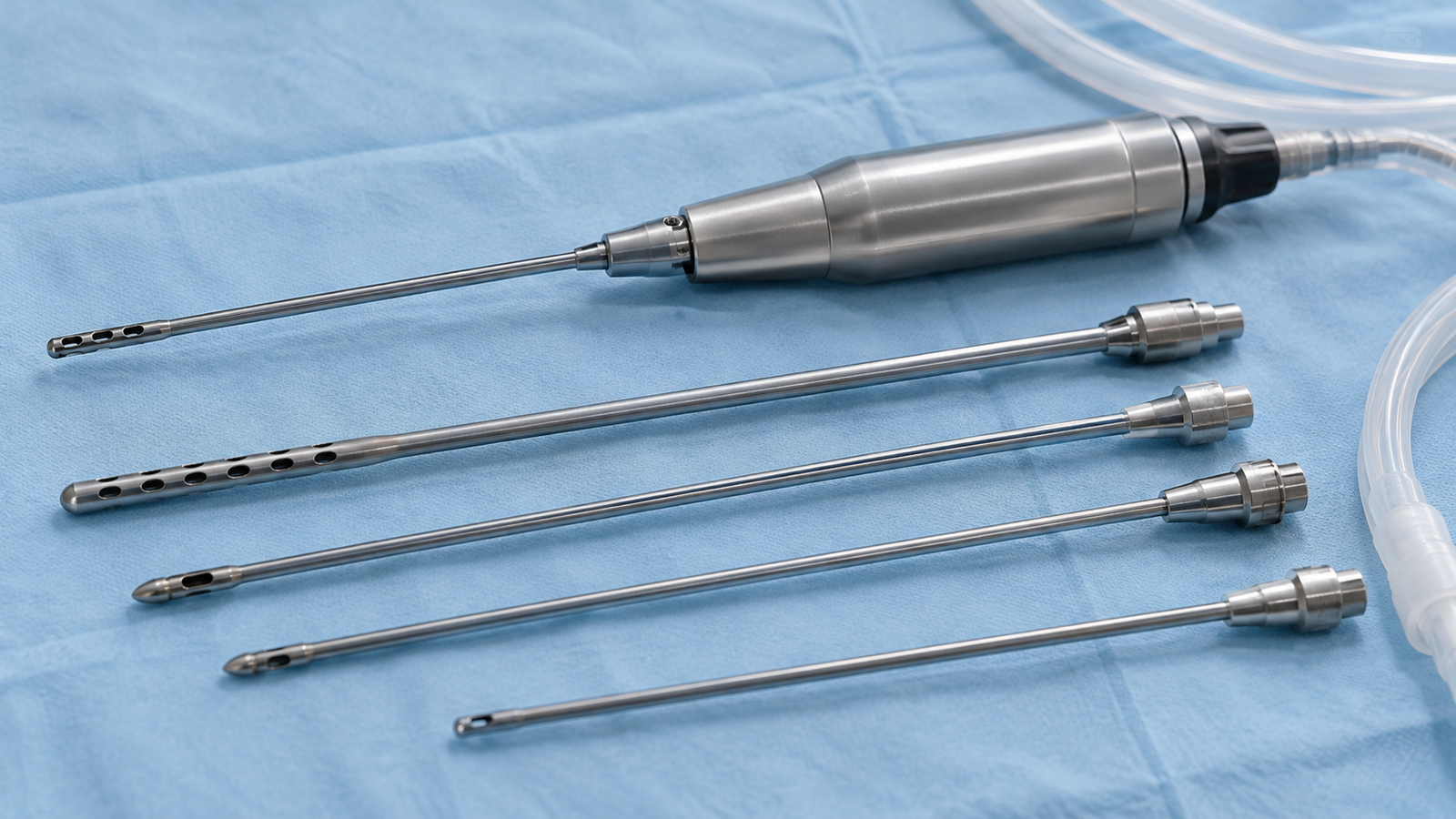
Power-assisted liposuction, often called PAL, uses a mechanically moving cannula. Its short, rapid movements help the surgeon work through tissue with less manual effort.
PAL does not use ultrasound energy to emulsify fat. Its mechanical action can be useful in fibrous areas, including the chest, but the device alone does not ensure that all firm gland will be removed.
VASER ultrasound-assisted liposuction
VASER uses ultrasound energy before suction to help break down tissue for removal.
Ultrasound-assisted techniques can be useful in fibrous treatment areas. However, ultrasound adds an energy-delivery step, which requires appropriate training and precautions.
For a broader explanation, read Chest fat reduction by machine.
Comparison: fat, gland, skin and cost
| Technology | How it loosens fat | Effect on firm gland | Skin-tightening claim | Extra cost driver | Evidence source |
|---|---|---|---|---|---|
| Standard liposuction | Manual cannula movement with suction | Dense gland may need excision | Skin may retract, but excess skin can remain | Surgical time, facility and procedure extent | ASPS procedure guidance |
| Power-assisted liposuction | Mechanically moving cannula with suction | May help work through fibrous tissue; separate gland removal may still be needed | Does not guarantee adequate skin retraction | Device use, consumables and operating time | Published liposuction reviews |
| VASER liposuction | Ultrasound treatment followed by suction | Can reduce selected fatty-glandular tissue; dense residual gland may require removal | Retraction varies with skin quality and treatment | Equipment, probes, consumables and additional treatment time | Comparative studies and surgical series |
| VASER with J-Plasma | Ultrasound and suction, followed by a separate energy treatment | Does not automatically establish complete gland removal | Adds a skin-contraction treatment with its own risks | Additional device, consumables, and treatment step | Small 2024 comparative study |
This table describes the procedures rather than ranking them. J-Plasma is a separate intervention; its effects should not be presented as benefits of VASER alone.
Does VASER remove gland or only fat?
It is too absolute to say that VASER affects only fat. Some published techniques report reduction of the fatty-glandular component.
However, it is equally misleading to promise that VASER will remove every firm gland without another technique.
The American Society of Plastic Surgeons explains that liposuction may be used for predominantly fatty enlargement, while excision is recommended when glandular tissue or excess skin needs removal. Some patients need both.
A practical planning rule is:
Liposuction addresses fat; persistent firm gland may require excision; excess skin needs its own assessment.
Gland removal can involve a small areolar incision or another surgical approach. The choice depends on the tissue, access needed, and contour plan.
Ask the surgeon what happens if a firm disc remains after liposuction. A clear answer is more useful than a promise based on the device name.
Read Pure glandular gynecomastia for more about gland-dominant enlargement.
What do published comparisons show?
The evidence suggests possible benefits in selected settings. It does not support a universal claim that every technique produces identical results or that one machine is always superior.
The 2024 comparison: traditional liposuction, VASER and VASER with J-Plasma
A prospective study in Plastic and Reconstructive Surgery Global Open included 45 patients, with 15 in each group. Participants were allocated using sealed envelopes and followed for six months.
The researchers reported advantages for VASER-based treatment, particularly the combined J-Plasma approach, in measured tissue reduction, skin outcomes, and satisfaction.
Important limitations are the small groups, selected patients, and limited follow-up. The “traditional” arm included power-assisted treatment, so this was not a clean comparison between purely manual liposuction and PAL. Its measurement of the subareolar disc also does not prove complete gland removal in every patient.
The 2025 multicentre series: VASER combined with gland excision
The study identified by PubMed PMID 40131397 examined VASER plus gland excision through a minimal scar incision.
That distinction matters. Findings from a combined operation cannot establish that VASER alone produces the same result or makes gland excision unnecessary.
Earlier comparisons also found differences
A 13-year review reported fewer conversions to open excision and fewer revisions with ultrasound-assisted liposuction than conventional liposuction.
However, a historical review cannot establish what will happen for every patient treated today. Patient selection, surgical technique, and experience affect how findings should be applied.
| Evidence | What it helps explain | What it cannot establish |
|---|---|---|
| Small 2024 comparative study | Differences between selected treatment approaches | A universal advantage across all chest types |
| 2025 VASER-plus-excision series | Outcomes of a combined surgical approach | That VASER alone replaces gland excision |
| Earlier ultrasound comparison | Possible differences in excision and revision requirements | Guaranteed individual outcomes |
The evidence should guide selection, rather than replace an examination.
Can a machine tighten loose chest skin?
Skin response depends on the amount of excess skin, elasticity, previous weight changes, and the position of the nipple.
Reducing chest volume may allow some skin to retract. Nevertheless, a large fold or low nipple position may require skin excision or repositioning.
Energy-assisted contraction is not interchangeable with removing substantial excess skin. Ask what degree of improvement is realistic and whether a second procedure might still be needed.
For chests with a roll or fold, read Is liposuction enough for type 4?.
Does the machine change cost, swelling or recovery?
Cost
Chest fat liposuction cost depends on more than equipment. The quote may include gland excision, skin treatment, anaesthesia, theatre charges, garments and follow-up.
VASER may cost more because of equipment, consumables and additional treatment time. A higher price does not establish that it offers greater benefit for your particular chest.
Compare complete plans. A liposuction-only quote and a liposuction-plus-excision quote describe different operations.
Read What a gynecomastia quote pays for before comparing prices.
Swelling and bruising
All approaches can cause swelling and bruising. Their extent also depends on treatment volume, gland removal, bleeding control, and individual healing.
A claim that PAL or VASER “always causes less bruising” needs stronger support than photographs from selected patients.
Recovery
Recovery follows the whole operation. Additional gland or skin removal may change restrictions, even when the same liposuction device is used.
Ask for individual guidance on work, driving, lifting, exercise, and garment use. Avoid choosing a technique solely because an advertisement promises a fixed return date.
Can VASER cause burns?
Yes. Ultrasound-assisted liposuction introduces a thermal injury risk. Standard and power-assisted methods do not use that ultrasound energy step, although they still carry other surgical risks.
Published reviews distinguish mechanical PAL from energy-assisted methods and discuss the relevance of heat to skin burns.
Ask how the surgeon protects access sites, monitors tissue response, and avoids excessive treatment. Relevant risks also include bleeding, fluid collection, altered sensation, asymmetry and contour irregularities.
“Advanced technology” should come with a clear explanation of precautions and limitations.
Questions to ask about Vaser chest liposuction Vadodara
Before booking, ask:
- Is my enlargement mainly fat, gland, or a combination?
- Why does this device suit my tissue?
- Will you remove the gland separately if necessary?
- Does my skin need excision or another treatment?
- What scars and contour limitations should I expect?
- What is included in the quote?
- Who manages anaesthesia and postoperative concerns?
At Elegance Clinic, you can discuss these decisions with Dr. Ashutosh Shah, whose published profile lists more than 22 years of surgical experience. The consultation should connect the proposed technology to your tissue and treatment goals. Gynecomastia Surgeon India
Why might the chest remain puffy after liposuction?
Early puffiness may reflect postoperative swelling. Later fullness can require assessment for residual fat, gland, scar tissue, or another cause.
It should not automatically be labelled “gland left behind” from a photograph. Nor should every firm area be assumed to need revision.
Ask your surgeon when the contour can be meaningfully assessed. Rapidly increasing swelling, worsening pain, or other unexpected changes need prompt contact with the surgical team.