
Is Liposuction Enough to Treat Type 4 Gynecomastia?
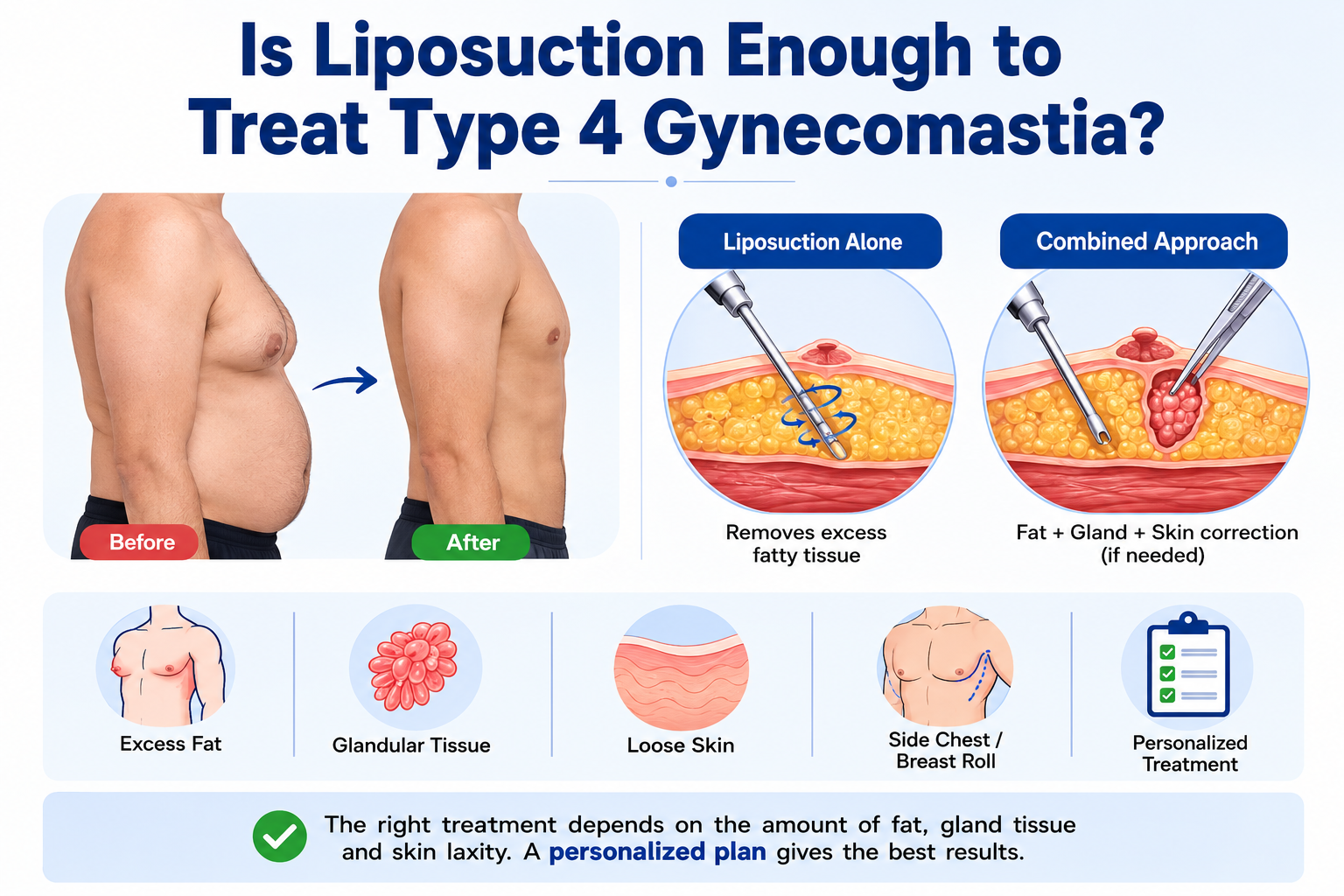
Liposuction alone is not always enough to treat Type 4 gynecomastia. Type 4 cases can involve a combination of excess fat, firm glandular tissue, significant breast enlargement, and loose or sagging skin. Therefore, treatment usually needs to be planned according to the type and amount of tissue present.
For some men, liposuction can provide significant improvement. However, when there is substantial glandular tissue or excess skin, gland excision and skin tightening or removal may be needed along with liposuction.
What Is Type 4 Gynecomastia?
Type 4 gynecomastia generally represents a more advanced form of male breast enlargement. The chest may appear larger, heavier, or more feminine, and excess skin can contribute to a noticeable breast roll.
In some patients, tissue may also extend toward the sides of the chest or armpit area.
The condition can involve:
- Excess fatty tissue
- Firm glandular breast tissue
- Loose chest skin
- Sagging of the breast area
- Side chest or axillary tissue
- A noticeable breast roll
Because several types of tissue may be present, simply removing fat may not completely correct the chest shape.
What Can Liposuction Treat?
Liposuction is particularly useful for removing excess fatty tissue from the chest.
During the procedure, a surgeon uses a small cannula to remove unwanted fat and improve the overall chest contour.
Liposuction may help:
- Reduce chest volume
- Remove excess fatty tissue
- Improve chest definition
- Contour the sides of the chest
- Reduce some areas of the breast roll
However, liposuction does not remove significant amounts of firm glandular tissue, and it cannot remove large amounts of loose skin.
When Is Liposuction Alone Enough?
Liposuction alone may be suitable when most of the enlargement is caused by excess fat and the skin has good elasticity.
For example, a patient may have:
- Predominantly fatty tissue
- Minimal glandular enlargement
- Good skin elasticity
- Limited skin excess
- No significant sagging
In such cases, removing the excess fat may allow the skin to contract naturally and create a flatter chest.
However, Type 4 gynecomastia frequently involves more than just excess fat, so an examination is important before choosing liposuction alone.
When Is Gland Removal Necessary?
Gynecomastia can involve firm glandular tissue beneath the nipple and areola. This tissue does not respond to liposuction in the same way as soft fatty tissue.
If significant glandular tissue is present, the surgeon may need to remove it surgically.
A combined approach can involve:
Liposuction + gland excision
Liposuction removes excess fat, while surgical excision addresses firm glandular tissue.
This combination can provide a more complete chest contour when both types of tissue contribute to the enlargement.
What About Excess Skin?
This is one of the most important considerations in advanced gynecomastia.
If the skin has stretched significantly, removing the underlying fat and glandular tissue may leave excess skin behind. In that situation, liposuction alone may not produce the desired flat appearance.
Depending on the amount of skin excess, the surgeon may recommend a procedure that includes skin tightening or skin removal.
The exact technique depends on:
- Amount of excess skin
- Degree of sagging
- Breast size
- Skin elasticity
- Position of the nipple and areola
- Amount of glandular and fatty tissue
Can Liposuction Remove the Breast Roll?
Liposuction can help reduce a moderate breast roll when excess fat is a major component.
However, a breast roll may also contain loose skin and glandular tissue. Therefore, simply removing fat may not eliminate the roll.
A surgeon may combine different techniques to address the underlying tissues and create a smoother transition between the chest, side chest, and armpit area.
Is Surgery Necessary for Type 4 Gynecomastia?
Not every patient requires the same surgical approach. However, advanced gynecomastia with significant glandular tissue and skin excess is more likely to require a combination of procedures.
Exercise and weight loss can reduce overall body fat, but they generally cannot remove established glandular breast tissue or significant loose skin.
Therefore, patients with persistent Type 4 gynecomastia may benefit from an assessment by an experienced cosmetic or plastic surgeon.
What Happens During Treatment?
The treatment plan is customized after examining the chest.
Depending on the findings, surgery may include:
- Liposuction to remove excess fat.
- Gland excision to remove firm breast tissue.
- Skin tightening or removal when there is significant loose skin.
- Nipple and areola repositioning in selected advanced cases.
Not every patient needs all four procedures.
The goal is to use the least extensive approach that can provide an appropriate and natural-looking chest contour.
What Is Recovery Like?
Recovery depends on the procedures performed.
After surgery, patients may experience swelling, bruising, tightness, and temporary tenderness. A compression garment may be recommended to support healing and help control swelling.
Patients should follow their surgeon's instructions regarding:
- Wound care
- Compression garments
- Exercise
- Heavy lifting
- Sleeping position
- Follow-up appointments
Returning to strenuous exercise too early may interfere with recovery.
Can Type 4 Gynecomastia Return After Surgery?
When excess fat and glandular tissue are appropriately treated, the results can be long-lasting. However, significant weight gain, hormonal changes, certain medications, or underlying medical conditions can contribute to recurrent or new breast enlargement.
Maintaining a stable weight and addressing any underlying causes can help support long-term results.
Final Takeaway
Liposuction alone may not be enough for Type 4 gynecomastia. It can effectively remove excess fatty tissue, but patients with significant glandular tissue or loose skin may need gland excision, skin correction, or a combination of techniques.
At Elegance Clinic, Dr. Ashutosh Shah, a Plastic, Reconstructive and Cosmetic Surgeon with more than 22 years of surgical experience, evaluates the amount of fat, glandular tissue, skin excess, and chest laxity before recommending a personalized treatment plan.