
How to Sleep After Gynecomastia Surgery: Position, Pillows and the First Two Weeks
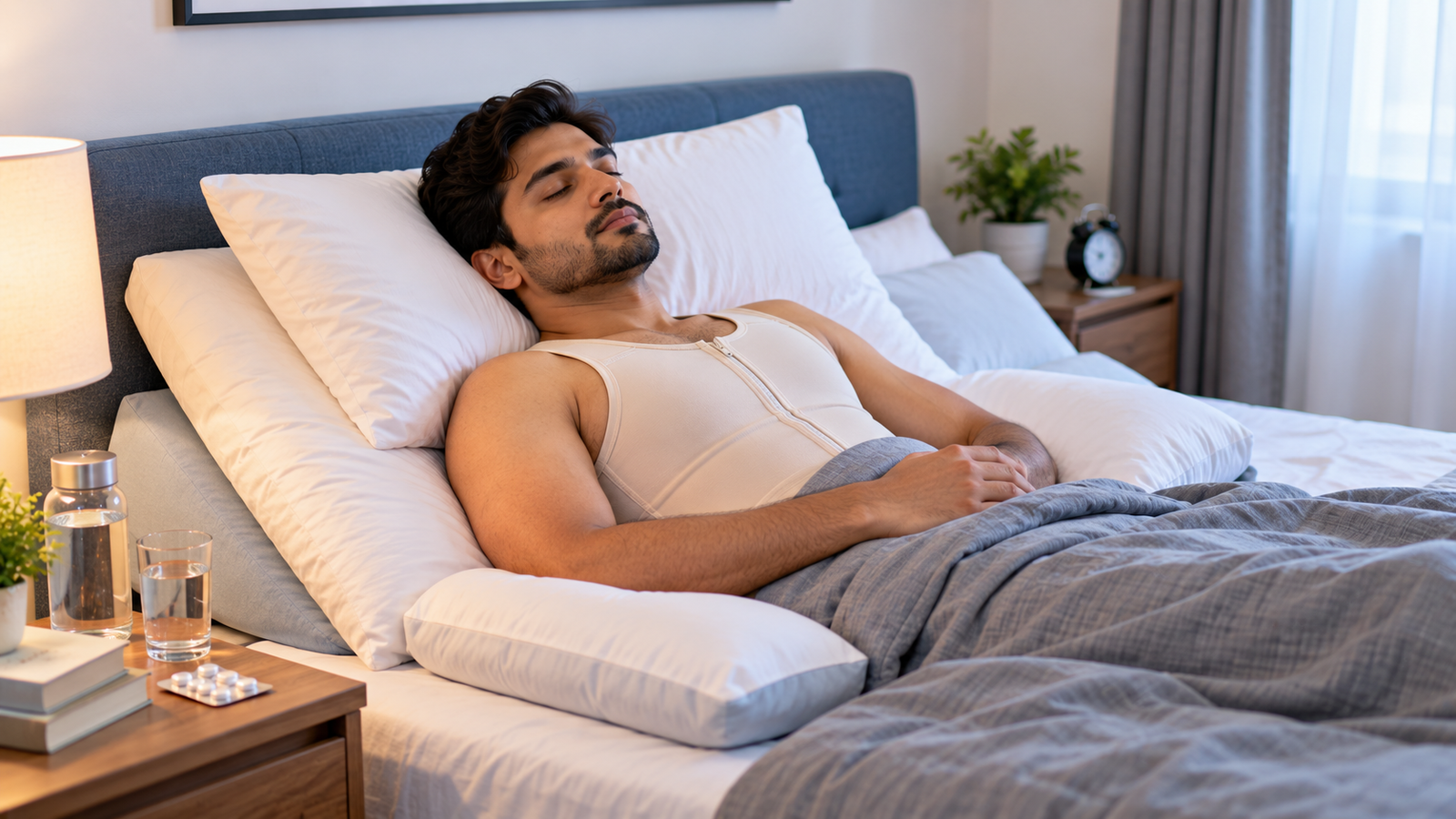
What is the correct sleeping position after gynecomastia surgery? During early recovery, patients are commonly advised to sleep on their back with the upper body slightly elevated, rather than directly on the chest or side. Pillows or a recliner can make this position more comfortable. The exact duration of sleeping restrictions should follow your surgeon's postoperative instructions.
Sleep can feel surprisingly awkward during the first few nights after gynecomastia surgery. Even patients who have little daytime discomfort may notice tightness, stiffness, or difficulty finding a comfortable position at bedtime.
The goal is not to create a complicated pillow arrangement. It is to find a stable position that avoids unnecessary pressure on the healing chest and allows you to get in and out of bed without excessive upper-body strain.
Why Is Back Sleeping Advised in the First Weeks?
Sleeping on your back keeps direct body weight away from the operated chest.
After gynecomastia surgery, the tissues may be swollen and tender. Liposuction, gland removal, or both may have been performed, and the chest needs time to heal.
Side sleeping can place uneven pressure on one side of the chest. Sleeping face-down places more direct pressure across the operated area.
A supported back-sleeping position can therefore help you avoid unnecessary compression or twisting during the early postoperative period.
However, sleeping restrictions are not identical for every patient. Follow the specific post-operative guidelines provided by your surgical team.
How Should Pillows Be Arranged for Support?
You do not need a large pile of pillows.
The aim is to create a comfortable, stable incline without bending your neck sharply forward.
A practical arrangement may include:
- One or two supportive pillows behind the upper back and shoulders
- A normal pillow supporting the head and neck
- A pillow beneath the knees if it makes the lower back more comfortable
- Pillows beside the body if you tend to roll onto your side while asleep
A wedge pillow can also provide more consistent elevation than several loose pillows.
Make sure the shoulders and upper back are supported rather than elevating only the head. If only your head is pushed forward, you may wake with neck discomfort.
Sleep Position After Gynecomastia Surgery
| Recovery period | Recommended position | Support needed | What to avoid |
|---|---|---|---|
| First few nights | Back, with upper body comfortably elevated | Wedge or supportive pillows behind upper back; optional knee pillow | Stomach sleeping and unnecessary chest pressure |
| Week 1 | Primarily supported back sleeping | Pillows that prevent rolling and keep the torso comfortable | Forceful turning, unsupported side sleeping |
| Week 2 | Usually continue back sleeping unless surgeon allows otherwise | Gradually reduce elevation if comfortable and permitted | Returning to a preferred position simply because pain has improved |
| After early healing | Position may gradually become less restricted | Support as required for comfort | Side/front sleeping until specifically appropriate for your recovery |
| Later recovery | Normal sleeping positions can generally return progressively | Usually minimal | Any position that causes pain or significant pressure |
Important: This is a general planning guide, not an individual clearance schedule. The procedure performed and your surgeon's protocol determine when sleeping restrictions can change.
How Many Pillows Should Be Used?
There is no required number.
For one person, two supportive pillows may create a comfortable incline. Another may find a wedge pillow plus a normal head pillow more stable.
More pillows are not automatically better.
If the arrangement causes your neck to bend forward, your lower back to ache, or your body to slide down during the night, adjust it.
The objective is comfortable upper-body support, not maximum elevation.
Is It Safe to Sleep in a Recliner?
A recliner can be useful for some patients during the first part of recovery because it naturally supports a semi-upright position and may make accidental rolling less likely.
It may also make standing up easier because you do not have to push yourself up from a completely flat bed.
However, a recliner is not compulsory.
If you can create a stable and comfortable position in your normal bed, there may be no reason to sleep elsewhere.
If your surgeon has given specific positioning instructions, those instructions should take priority.
When Can I Sleep on My Side Again?
There is no universal day on which every patient can safely return to side sleeping.
The timing depends on the extent of surgery, swelling, tenderness, incision healing, and your surgeon's protocol.
Even when side sleeping is eventually permitted, start gradually. If lying on one side produces pressure, pulling, or pain around the chest, return to the supported position and discuss it at your follow-up.
Do not interpret "I can tolerate it" as the same thing as "my surgeon has cleared it."
For the broader activity timeline, see recovery after male breast reduction.
When Can I Sleep on My Stomach?
Stomach sleeping generally requires more caution because it places direct pressure across the chest.
It should therefore not be your early postoperative sleeping position.
Return to front sleeping only when healing has progressed sufficiently, and your surgeon considers direct chest pressure appropriate.
If you naturally sleep on your stomach, positioning pillows along your sides during early recovery may help reduce unconscious rolling.
What If I Wake Up on My Stomach?
Do not panic.
If you accidentally change position during sleep, gently return to the recommended position.
Check how you feel. An accidental brief change of position does not automatically mean you have damaged the surgical result.
However, contact your surgical team if you notice a significant new change afterward, such as rapidly increasing swelling, bleeding, severe pain, or another concerning symptom.
Trying to remain awake because you are afraid of moving can make recovery unnecessarily exhausting. Instead, use pillows to make your recommended position easier to maintain.
Does the Compression Vest Stay On at Night?
If your surgeon has instructed you to wear a compression garment continuously during a particular stage of recovery, that generally includes sleeping unless you have specifically been told otherwise.
Do not independently remove the vest every night because it feels inconvenient.
Likewise, do not make it excessively tight in an attempt to reduce swelling faster.
Compression instructions can vary according to the operation and surgeon, so follow the schedule given to you rather than copying another patient's routine.
If the garment causes severe discomfort, significant skin irritation, or another problem, contact the surgical team.
How Is Night-Time Pain Managed?
Discomfort can sometimes feel more noticeable at night because there are fewer distractions and the body remains in one position for longer.
Use only pain medicines that have been prescribed or approved for you, and follow the instructed dose and timing.
Do not add over-the-counter medicines, sleeping tablets, herbal preparations or alcohol simply to make yourself sleep without checking whether they are appropriate after your procedure.
Preparing the bedside area before lying down can also help.
Keep water, permitted medicines, your phone and anything else you may reasonably need within easy reach so that you do not repeatedly stretch or twist during the night.
Information about preparation and discharge can also be found in On the day of your surgery.
Why Does the Chest Feel Tighter in the Morning?
Some patients notice stiffness or tightness after remaining relatively still overnight.
Early postoperative swelling and healing tissues can contribute to this sensation.
It may become more noticeable when you first get out of bed and then feel different after gentle normal movement.
A feeling of tightness alone does not establish that something is wrong. What matters is whether symptoms are following the expected recovery pattern or suddenly becoming worse.
New severe pain, rapidly increasing swelling, or other significant changes should be reported rather than assumed to be ordinary morning stiffness.
How Can You Get Out of Bed Without Straining the Chest?
Getting out of bed can be uncomfortable during the first few days.
Avoid forcefully pushing your entire body upright using your arms.
Instead, move slowly and use your legs and core as comfortably as possible while following the movement instructions provided after surgery.
Having an attendant nearby during the earliest recovery period can also be useful, particularly after anaesthesia or when you first return home.
Your surgical team can demonstrate a comfortable method before discharge if getting in and out of bed is a concern.
How Can You Sleep Better During the First Week?
Prepare your sleeping setup before surgery.
Test your wedge or pillow arrangement in advance rather than trying to build it when you are tired after returning home.
Keep the bedroom comfortably cool, especially if you are wearing a compression garment.
Avoid placing heavy blankets directly across a tender chest if they feel uncomfortable.
Also try to maintain a regular sleep routine. Postoperative discomfort and daytime resting can temporarily alter normal sleep patterns, so one poor night's sleep does not necessarily indicate a problem.
Which Night-Time Signs Should Be Reported?
Some swelling, bruising, tightness and discomfort can be expected after surgery. However, certain changes deserve prompt medical advice.
Contact your surgical team if you develop rapidly increasing or markedly one-sided swelling, significant bleeding, worsening redness, wound discharge, fever, severe or escalating pain, breathing difficulty, or a sudden deterioration in how you feel.
Do not simply take additional pain medicine and wait until morning when symptoms appear severe or rapidly progressive.
If you are worried that recovery is not following the expected course, see When chest fat removal goes wrong for additional information about problems that need assessment.
When Can Sleeping Return to Normal?
Normal sleep positions should return progressively rather than according to a rigid online timetable.
Dr. Ashutosh Shah, with 22+ years of experience in plastic and cosmetic surgery, can advise when side or front sleeping is appropriate based on the procedure performed and how the chest is healing.
During follow-up at Elegance Clinic, Surat, patients can also ask about compression garment use, exercise, work, and other activity restrictions as recovery progresses.
The important principle is simple: feeling better is encouraging, but it does not necessarily mean every postoperative restriction should immediately stop.
Key Takeaways
The simplest answer to how to sleep after gynecomastia surgery is to use a supported back-sleeping position during early recovery, with the upper body comfortably elevated according to your surgeon's instructions.
Arrange pillows beneath the upper back rather than simply stacking them beneath your head. Side and stomach sleeping should return gradually rather than according to a fixed date.
Wear the compression garment at night if that is part of your prescribed schedule, and contact the surgical team if nighttime symptoms include rapidly increasing swelling, significant bleeding, worsening redness, fever, breathing difficulty, or severe escalating pain.