
Planning Gynecomastia Surgery Before a Wedding: How Far Ahead to Book
How many months before a wedding should gynecomastia surgery be done? For elective planning, allowing around 3–6 months before the wedding gives swelling, chest contour, and scars more time to settle and leaves room for clothing fittings and routine follow-up. A shorter interval may sometimes be workable, but recovery varies, and the final result should never be promised by a particular date.
Wedding planning creates a different kind of deadline from ordinary gynecomastia surgery. The question is not simply when you can return to work. You also need to consider when a fitted sherwani or suit will sit comfortably, whether a compression garment is still required, how much swelling remains, and whether the chest contour is stable enough for final tailoring.
How Long Does Visible Swelling Take to Settle?
Swelling is expected after gynecomastia surgery.
It is usually more noticeable during the early recovery period and gradually improves over the following weeks. However, the chest does not necessarily reach its final contour as soon as the obvious swelling disappears.
Residual swelling, firmness, and small differences between the two sides can persist while the tissues continue healing.
This distinction matters when surgery is being planned around a wedding.
You may feel comfortable attending normal activities relatively early, while the chest is still changing enough that a very closely fitted outfit should not yet be considered the final fit.
For a broader recovery overview, see Recovery after male breast reduction.
Wedding Countdown: When Should Surgery Happen?
There is no single guaranteed recovery timetable. The following is a practical planning framework rather than an individual medical clearance.
| Time before wedding | What ideally should have happened by then | What to avoid |
|---|---|---|
| 6+ months | Consultation, assessment and surgery can be planned with a generous recovery margin | Unnecessary last-minute scheduling |
| 3–6 months | A useful window for surgery in many elective wedding plans | Assuming the exact final contour date can be guaranteed |
| 2–3 months | Much early recovery may occur before the wedding, but residual swelling can still vary | Finalizing extremely tight clothing too early |
| 1–2 months | Timing becomes less predictable for appearance-sensitive planning | Expecting all swelling, firmness, or scars to have matured |
| Final month | Ideally focused on routine recovery and final clothing adjustments | Elective last-minute procedures or unplanned aggressive treatments |
| Wedding week | Follow the existing postoperative plan and concentrate on comfort | Experimenting with new scar treatments, strenuous workouts, or last-minute corrections |
The safest timing depends on the extent of surgery and your surgeon's assessment.
Is Three Months Enough Before a Wedding?
For many patients, three months provides substantially more recovery time than scheduling surgery only a few weeks before the event.
However, "enough" depends on what you expect.
Three months may provide time for the initial recovery and considerable reduction in swelling, but it cannot guarantee that every trace of swelling, firmness, asymmetry, or scar redness will have disappeared.
Patients undergoing more extensive correction may also have a different recovery course from someone undergoing a smaller procedure.
If your wedding date is fixed and appearance in closely fitted clothing is especially important, earlier planning provides a larger buffer.
What Is the Minimum Safe Gap Before the Wedding?
There should not be a universal online rule such as "surgery is safe exactly four weeks before a wedding."
A minimum interval depends on:
- Extent of gland removal
- Amount of liposuction
- Skin excess
- Individual swelling
- Wound healing
- Postoperative complications, if any
- Compression garment requirements
- Wedding travel
- Physical demands of ceremonies
- Clothing style
The closer surgery is scheduled to the wedding, the less room there is for normal variation in recovery.
For a purely elective procedure tied to an important event, more recovery time is generally preferable to trying to find the shortest possible interval.
When Does Fitted Clothing Start to Look Right?
This is one of the most important questions for a groom.
After surgery, chest dimensions can continue changing as swelling reduces. Clothing fitted very early may therefore fit differently several weeks later.
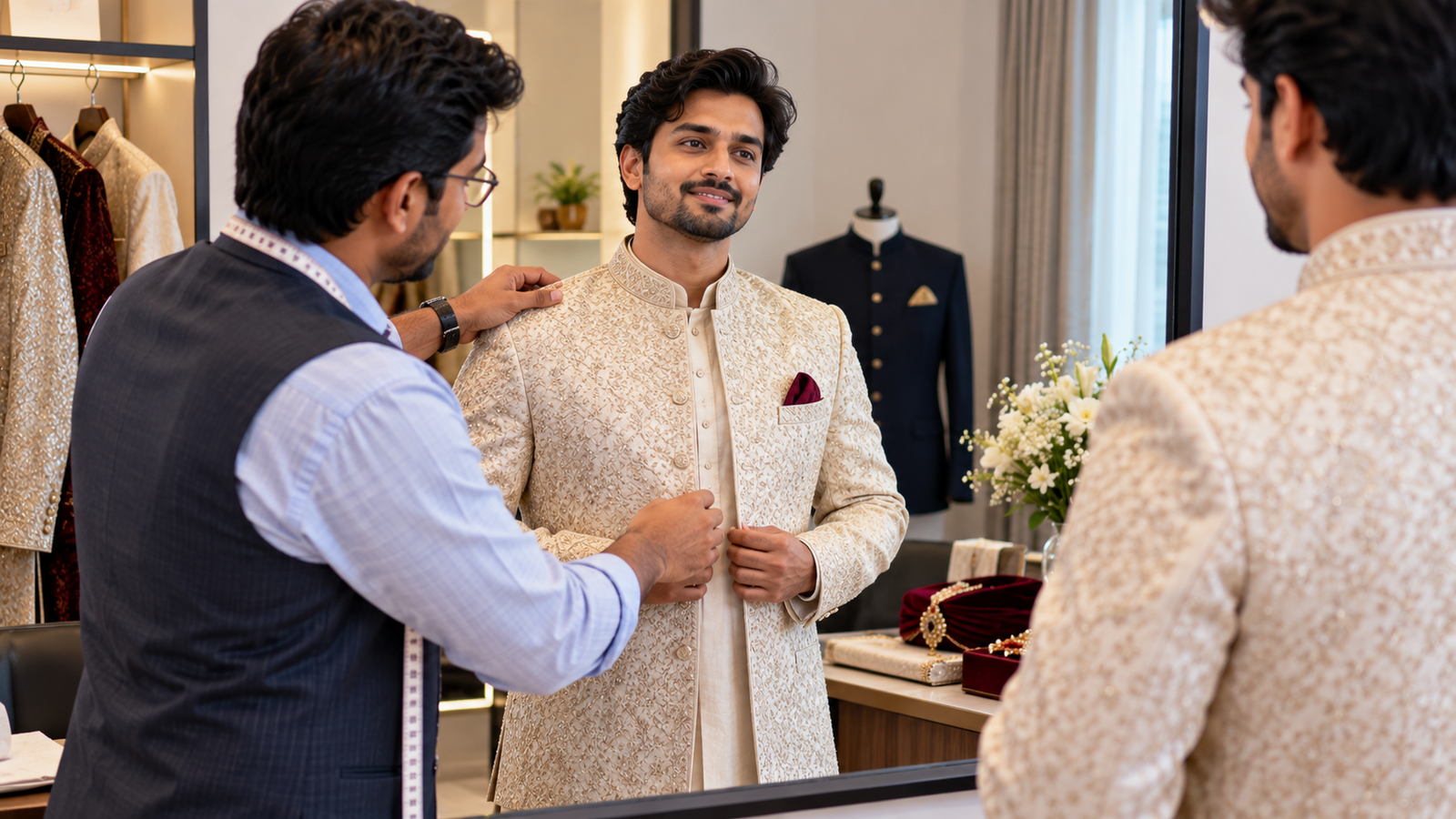
Loose everyday clothing is usually easier to manage during early recovery. Final tailoring of a closely fitted sherwani, bandhgala or suit should ideally happen when the chest contour has become reasonably stable.
That does not mean you cannot begin choosing fabrics or designs earlier.
A practical approach is to complete the broad tailoring process in advance but leave enough scope for final chest and armhole adjustments closer to the wedding.
When Should a Sherwani or Suit Be Stitched?
Do not use the surgery date as the only reference point.
Tell the tailor that your chest measurements may change during recovery.
For a highly structured sherwani or fitted suit, consider delaying the final chest fitting until postoperative swelling has substantially settled and your surgeon is satisfied with recovery.
If the outfit must be ordered earlier, ask whether the tailor can leave sufficient allowance for later adjustment.
This is particularly useful for:
- Sherwanis
- Bandhgalas
- Structured jackets
- Slim-fit suits
- Fitted kurtas
- Clothing with a closely tailored chest
The goal is to avoid having an expensive outfit finalized according to temporary postoperative measurements.
How Should Compression Garment Wear Be Planned Around Functions?
A compression garment may be recommended following gynecomastia surgery. The duration and daily wearing schedule should come from the operating surgeon.
Do not shorten the prescribed schedule simply because a pre-wedding function is approaching.
If you have an engagement, sangeet, reception, photoshoot, or another event during recovery, discuss the date with your surgeon beforehand.
Depending on your stage of recovery, the surgeon can tell you whether temporary removal is appropriate.
The Post-operative guidelines provide additional recovery information.
Can the Vest Be Removed for a Function?
Possibly, depending on how far you are into recovery and the instructions given for your particular operation.
It should not be assumed that because the function lasts only a few hours, removing compression is automatically appropriate.
If you know important functions will occur shortly after surgery, provide the dates during your consultation.
That allows postoperative garment use to be considered when choosing the operation date.
Will the Scar Be Visible in Wedding Photographs?
Gynecomastia scars change over time.
Early scars may appear more noticeable before gradually maturing. Their visibility depends on the incision used, individual healing, skin characteristics, and clothing.
Most traditional wedding outfits cover the chest, so the scar itself would ordinarily not be visible through clothing.
If photographs will involve an open-neck outfit, swimming, beach events, or another situation exposing more of the chest, discuss this during surgical planning.
Scar maturation takes longer than the basic return-to-work period. Do not schedule surgery close to the wedding with the expectation that a scar will become completely invisible by the event.
For additional information, see the Chest scar revision guide.
What If Swelling Is Uneven Close to the Wedding?
Some asymmetry during recovery can reflect unequal swelling rather than the final surgical result.
Do not try to correct it yourself through aggressive massage, tight additional garments, supplements, diuretics, or unapproved treatments.
Contact the surgical team.
They may recommend observation, examination or another appropriate step depending on the cause.
Sudden or rapidly increasing one-sided swelling, particularly when accompanied by significant pain, redness, bleeding, fever, or wound problems, requires prompt medical assessment rather than waiting for a scheduled wedding-related review.
Is a Touch-Up Possible Before the Wedding?
Do not plan the original surgery assuming that a quick touch-up can simply be performed shortly before the wedding.
The chest needs time to heal and settle before residual contour concerns can be properly assessed. Early postoperative swelling can make it difficult to distinguish temporary healing changes from an issue that might persist.
If revision is genuinely required, its timing should be determined medically rather than by the event calendar.
Creating additional swelling or healing immediately before the wedding could defeat the reason for seeking a touch-up.
What Should Be Avoided in the Final Month Before the Wedding?
If surgery was completed several months earlier and recovery is progressing normally, the final month should generally be about maintaining the established recovery plan rather than making dramatic changes.
Avoid suddenly starting aggressive chest workouts without clearance, experimenting with unapproved scar treatments, undergoing last-minute corrective procedures, or changing compression use against medical advice.
Wedding preparations can also involve travel, late nights, and long functions. Discuss these practical demands if they overlap with your recovery period.
Exercise and Wedding Preparation
Many grooms want to improve their overall physique before the wedding.
Exercise after surgery should progress according to recovery rather than the wedding countdown.
Walking and light activity generally return before strenuous chest exercise and heavy lifting. Do not accelerate resistance training simply because a wedding photoshoot is approaching.
For patients considering surgery specifically to improve chest contour under clothing, read more about Male chest contouring.
Plan Around the Wedding, Honeymoon and Travel
The wedding day is not the only date that matters.
Consider the entire schedule:
Pre-wedding functions: Engagement, haldi, mehendi, sangeet and family events may involve long days.
Wedding: Heavy embroidered clothing can feel warm and restrictive.
Travel: Destination weddings may involve flights or long road journeys.
Honeymoon: Swimming, gym activities, beaches, and luggage handling can affect planning.
Photography: Pre-wedding shoots may occur weeks before the actual wedding.
Therefore, when telling your surgeon your wedding date, also mention important functions and planned travel.
Why Earlier Planning Is Better
Scheduling surgery several months ahead creates flexibility.
If recovery proceeds smoothly, the extra time simply becomes a comfortable buffer.
If swelling takes longer than expected, tailoring needs adjustment or an additional review is required, you have time to manage it without the wedding being only days away.
At Elegance Clinic, Surat, patients planning surgery around a wedding can discuss the complete event calendar rather than considering only the operation date.
Discuss the Date Before Booking the Venue-Driven Deadline
Dr. Ashutosh Shah, with 22+ years of experience in plastic and cosmetic surgery, can assess the extent of correction required and explain how the expected recovery relates to the patient's wedding, clothing fittings, work schedule, and travel plans.
The aim is not to promise that the chest will look "perfect" by a particular day. It is to provide enough recovery margin that normal healing is less likely to interfere with an important event.
Key Takeaways
For a gynecomastia surgery before a wedding timeline, planning around 3–6 months provides a more comfortable recovery margin than leaving surgery until the final few weeks.
Visible swelling often improves before the tissues have completely settled, so final sherwani or suit alterations should not be based on very early postoperative measurements. Compression garment use, exercise, pre-wedding functions, photography, travel, and the honeymoon should all be included in the plan.
Most importantly, do not chase a minimum recovery interval. When the event date is fixed, scheduling earlier provides more flexibility for normal variations in healing.