
Local or General Anaesthesia for Gynecomastia Surgery: Which Cases Suit Each
Gynecomastia surgery can sometimes be performed under tumescent local anaesthesia, with or without sedation, for limited gland removal or smaller-volume liposuction. More extensive surgery, substantial skin removal, or difficulty tolerating an awake procedure may favour general anaesthesia. The decision depends on the operation, your health and assessment by the surgical and anaesthesia team.
Patients searching for “gynecomastia surgery local or general anesthesia” often want to know whether they must be asleep and whether an awake operation will hurt. Both approaches have a place. However, chest grade alone cannot decide which is suitable.
The team must consider the amount and distribution of gland and fat, skin excess, expected operating time, local anaesthetic dose, and your ability to remain comfortable.
What does tumescent local anaesthesia actually involve?
Tumescent anaesthesia involves injecting a dilute local anaesthetic solution into the tissue being treated. The solution commonly contains lidocaine, also called lignocaine, and adrenaline. It numbs the area, while adrenaline helps reduce bleeding.
For tumescent anaesthesia in chest surgery, the surgeon allows the solution to take effect and checks numbness before beginning. Initial injections can sting. During surgery, you may notice pressure, movement, or pulling, but sharp pain should be reported immediately.
Local anaesthesia and sedation are different:
- Local anaesthesia alone: You remain awake, and the treated area is numb.
- Local anaesthesia with sedation: Additional medicines help you relax or become drowsy. Awareness and memory vary with sedation depth.
- General anaesthesia: You are unconscious, and the anaesthesiologist manages your anaesthesia and breathing support.
Sedation still requires appropriate monitoring and the ability to manage breathing problems. An “awake” procedure also needs a plan if pain control is inadequate or you cannot tolerate continuing.
Published research describes gynecomastia correction using liposuction and gland excision under tumescent local anaesthesia in selected patients. This supports its use as an option, rather than a requirement for every case.
Which grades and body types are suitable for local anaesthesia?
Smaller, less extensive operations are often easier to perform while the patient is awake. Possible candidates include patients with localised gland enlargement, limited surrounding fat and little skin excess.
However, “grade 1 or 2” is only a starting description. Different grading systems use different criteria, and two chests with the same grade can require different operations.
Gland size and surgical extent
A small gland beneath the areola may need limited excision. A larger, dense gland can require more dissection and a longer procedure, even when there is relatively little fat.
Fat volume and treatment area
Limited chest liposuction may be suitable for local anaesthesia. Treating a broader area on both sides increases operating time, infiltration requirements and potential discomfort.
Body weight alone does not answer this question. A lean patient may have substantial gland tissue, while a heavier patient may have a predominantly fatty chest.
Skin excess and patient comfort
Minimal skin excess may allow correction without skin removal. Significant sagging may require a more extensive operation.
The patient must also be willing and able to remain still. Severe anxiety, difficulty lying comfortably or a previous unpleasant experience with awake procedures can influence the plan.
Gynecomastia surgery under local anesthesia therefore requires individual assessment, rather than selection from photographs or a grade label alone.
When does general anaesthesia become the safer choice?
General anaesthesia may offer a more controlled approach when surgery is extensive, prolonged or difficult to tolerate while awake. It allows the anaesthesiologist to manage unconsciousness, breathing and anaesthetic depth while the surgeon operates.
Factors that may favour it include:
- Broad bilateral liposuction or additional body areas being treated.
- Extensive gland dissection.
- Substantial skin excision or nipple repositioning.
- A long or technically demanding revision procedure.
- Severe anxiety or inability to remain comfortable and still.
- An anticipated local anaesthetic requirement that exceeds the team’s appropriate dosing plan.
These are practical considerations, not universal rules. Some experienced teams perform selected larger cases under local anaesthesia, while others recommend general anaesthesia for smaller operations.
General anaesthesia is also not automatically safer for every patient with a medical condition. Heart or lung disease, obesity, sleep apnoea and other conditions require assessment of both the anaesthetic technique and the facility where surgery will take place.
Anaesthesia decision table
The table below describes possible approaches. Liposuction volume must be estimated for the actual operation; there is no universal volume threshold that automatically separates local from general anaesthesia.
| Grade or extent | Tissue type | Expected liposuction volume | Skin excision needed | Usual anaesthesia consideration | Monitoring used |
|---|---|---|---|---|---|
| Small enlargement, often Simon I | Localised gland with little fat | None or limited | Usually no | Local may be suitable; sedation depends on need | Clinical observation and vital-sign monitoring appropriate to the plan |
| Moderate enlargement without excess skin, often Simon IIa | Gland and fat | Limited to moderate | Usually no | Local with or without sedation, or general | Monitoring matched to anaesthesia and sedation depth |
| Moderate enlargement with excess skin, often Simon IIb | Mixed tissue and loose skin | Variable | Sometimes | General may be favoured as surgical extent increases | Full anaesthesia monitoring when general is used |
| Marked enlargement with substantial excess skin, often Simon III | Gland, fat and skin excess | Variable; potentially extensive | Often | General commonly considered for extensive correction | Full anaesthesia monitoring and postoperative observation |
| Revision surgery, any grade | Scar tissue and residual gland or fat | Variable | Variable | Individual plan based on dissection and duration | Monitoring matched to the planned technique |
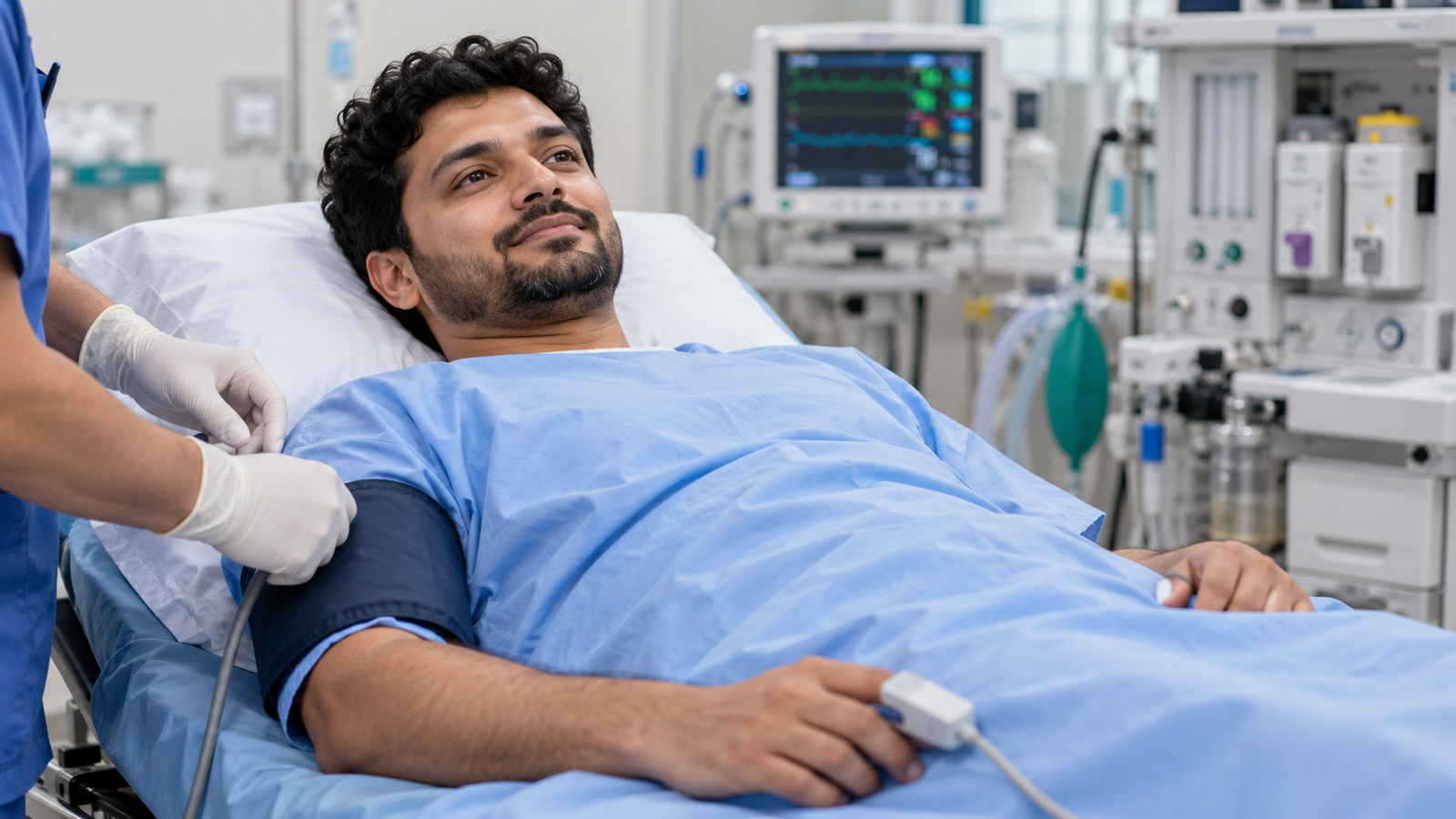
Under general anaesthesia, monitoring includes heart rhythm, blood pressure, oxygen saturation and exhaled carbon dioxide. Sedation also requires monitoring of breathing appropriate to its depth.
Does the choice change cost, recovery or discharge time?
Anaesthesia can affect the total bill through professional fees, medicines, equipment and recovery-room care. Local anaesthesia alone may reduce some of these costs, but the surgical fee and facility requirements remain.
Sedation adds its own medicines, monitoring and recovery needs. Request a written quote explaining the proposed technique and what it includes.
Recovery has two parts: recovery from anaesthesia and healing from surgery. An awake patient still has an operation to recover from. Swelling, dressings, compression garments and restrictions on exercise depend largely on the treatment performed.
General anaesthesia can cause temporary nausea, drowsiness or a sore throat. However, receiving it does not automatically mean an overnight admission.
Same-day discharge may be possible after either approach when the patient meets discharge criteria. These include adequate recovery, stable observations and controlled pain and nausea. Patients receiving sedation or general anaesthesia need arrangements for a responsible adult to take them home and follow the team’s aftercare instructions.
Read what happens on the day of surgery to prepare for admission and postoperative care.
Who makes the decision, and which fitness tests come first?
The surgeon assesses the correction required. The anaesthesiologist evaluates anaesthetic risks and discusses suitable options with you. Your preferences matter, but they must fit the clinical plan.
Assessment includes previous anaesthesia experiences, allergies, medications, supplements, smoking, alcohol use, sleep apnoea and relevant medical conditions.
Tests are selected according to your health and the operation. They may include blood tests, blood glucose assessment, or an ECG when indicated. Not every healthy patient needs an identical package.
What do ASA physical status classes mean?
The ASA classification describes overall health before anaesthesia:
- ASA I: A healthy patient.
- ASA II: A patient with mild systemic disease.
- ASA III: A patient with severe systemic disease.
- ASA IV: A patient with severe systemic disease that is a constant threat to life.
It does not determine anaesthesia by itself. Patients classified ASA III or higher generally need more extensive evaluation and coordinated care.
Review the Pre-operative guidelines, and discuss Surgery with diabetes or high BP when relevant.
Why is the lidocaine dose important?
The frequently cited 35 mg/kg figure comes from published tumescent lidocaine work; it is not a universal safe ceiling for every chest operation.
Klein and Jeske’s later study proposed preliminary estimates of 28 mg/kg without liposuction and 45 mg/kg with liposuction under studied conditions. Liposuction changes drug exposure by removing some infiltrated lidocaine. These estimates cannot simply be transferred to every patient or technique.
The clinical team must calculate the total dose, account for other local anaesthetics, and consider health conditions and drug interactions.
What should you ask before gynecomastia surgery in Pune?
Ask which tissues need treatment, whether skin removal is planned, and why the recommended anaesthesia suits your operation. Confirm who will provide anaesthesia, who monitors you, and what happens if the original plan needs to change.
At Elegance Clinic, discuss the surgical options and recovery requirements before making a booking.
The published profile of Dr. Ashutosh Shah, operating surgeon, describes more than 22 years of surgical experience. Experience supports surgical planning, while the anaesthesia assessment remains a separate part of preparation.