

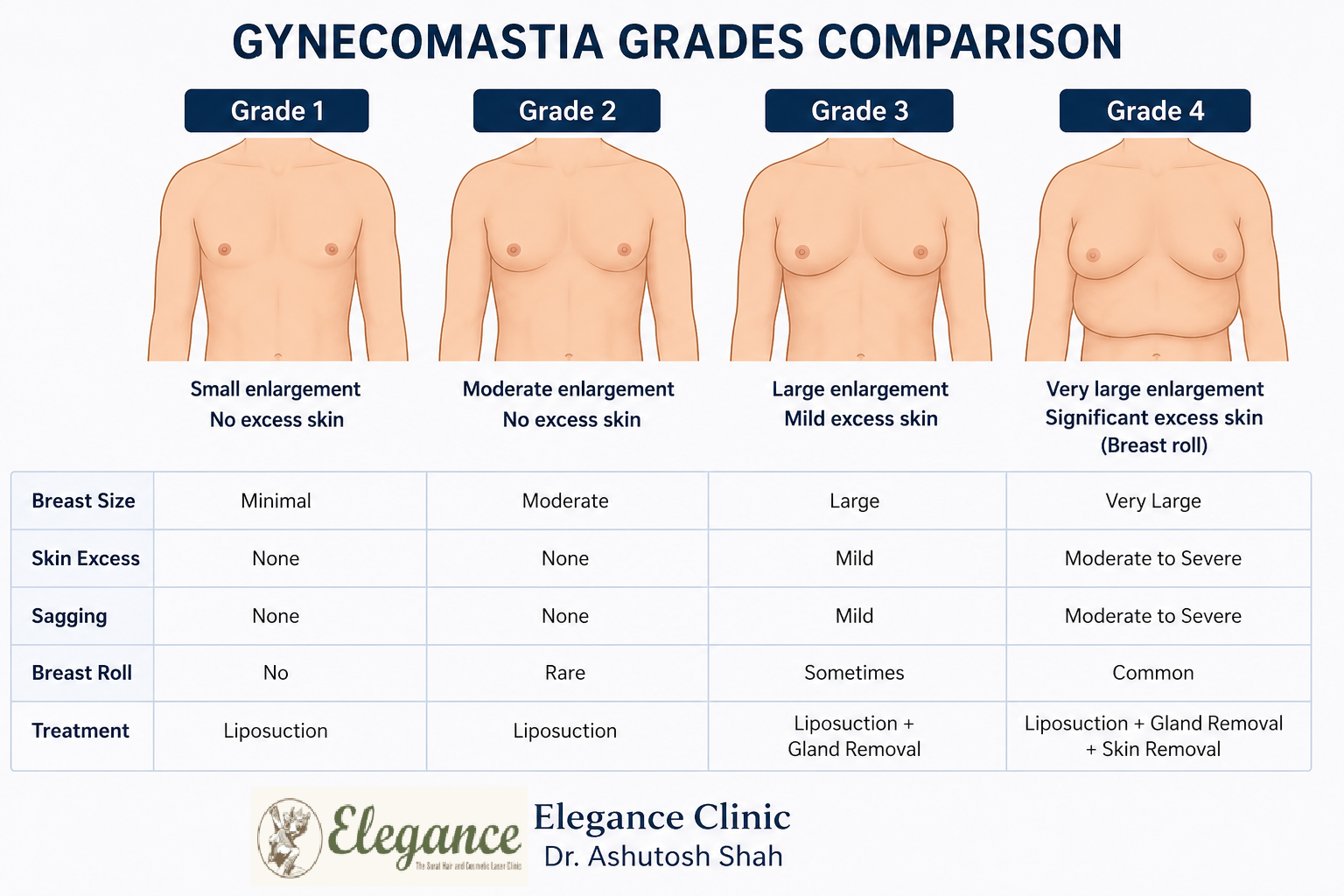
How Is Type 4 Gynecomastia Different From Other Grades?
Type 4 Gynecomastia Differences are mainly seen in the degree of chest enlargement, excess skin, sagging, and the overall shape of the male chest. Compared with milder forms of gynecomastia, Type 4 cases can involve more significant breast tissue and skin changes, which may require a more comprehensive treatment approach.
However, it is important to know that doctors use different classification systems for gynecomastia. For example, the Simon system describes Grade I as small enlargement without excess skin and Grade III as marked enlargement with excess skin. The Rohrich system uses Grade IV for severe enlargement with more advanced ptosis, or sagging.
What Does Type 4 Gynecomastia Mean?
Type 4 gynecomastia generally refers to a more advanced form of male chest enlargement. Depending on the classification system used, it can involve substantial breast tissue, excess skin, and noticeable sagging.
Some patients may also have a prominent breast roll extending toward the sides of the chest. Therefore, the appearance can be quite different from mild gynecomastia.
A physical examination is important because the severity does not depend only on breast size. Doctors also consider skin elasticity, the amount of glandular and fatty tissue, nipple position, and the degree of sagging.
How Is Type 4 Different From Milder Gynecomastia?
The main Type 4 Gynecomastia Differences become clearer when looking at the amount of enlargement and skin excess.
Mild Gynecomastia
Mild cases usually involve a small amount of tissue behind or around the nipple. There is generally little or no excess skin. The chest may look relatively normal except for a puffy nipple or small localized enlargement.
Moderate Gynecomastia
Moderate gynecomastia produces more noticeable chest enlargement. Depending on the classification, excess skin may or may not be present.
For some patients, the enlargement remains concentrated around the nipple. For others, it extends across a larger portion of the chest.
Advanced or Type 4 Gynecomastia
More advanced cases can involve significant breast enlargement along with excess skin and sagging. The nipple and areola may sit lower on the chest, and the breast contour can become more prominent.
Some classification systems specifically use Grade IV for severe enlargement with significant ptosis, or breast sagging.
Does Type 4 Gynecomastia Cause a Breast Roll?
It can. A larger amount of chest tissue and excess skin may create a visible fold or breast roll, particularly toward the lower or side portion of the chest.
However, a breast roll does not automatically mean that a patient has Type 4 gynecomastia. Different classification systems consider different features, and individual anatomy varies.
Therefore, a surgeon should assess the entire chest rather than determining the grade from appearance alone.
Can Weight Loss Correct Type 4 Gynecomastia?
Weight loss can reduce excess fat in the chest when excess body fat contributes to the appearance. However, weight loss does not reliably remove firm glandular tissue.
It may also leave loose skin behind when substantial weight has been lost. For this reason, some patients continue to have noticeable chest enlargement even after reaching a healthier weight.
A medical evaluation can determine whether the remaining chest fullness comes mainly from fat, glandular tissue, loose skin, or a combination.
Does Type 4 Gynecomastia Require Surgery?
Not every patient with significant gynecomastia automatically needs the same surgical procedure. Treatment depends on the underlying tissue, degree of enlargement, skin quality, and amount of sagging.
Surgical treatment may include:
- Liposuction to reduce excess fatty tissue
- Removal of firm glandular tissue
- Skin tightening or skin removal when significant excess skin is present
- A combination of techniques to improve the overall chest contour
Medical evaluation should also consider possible underlying causes before proceeding with definitive treatment.
Why Can Treatment Differ Between Patients?
Two men can have similar-looking chest enlargement but require different treatment plans.
For example, one patient may have mostly fatty tissue with good skin elasticity. Another may have substantial glandular tissue and loose skin. Liposuction may help the first patient, while the second may need gland removal and treatment of excess skin.
This is why gynecomastia treatment should be planned after examining the patient's chest structure rather than selecting a procedure based only on the grade.
How Is Type 4 Gynecomastia Diagnosed?
A surgeon typically evaluates:
- Breast size and shape
- Glandular tissue
- Chest fat
- Skin elasticity
- Skin excess
- Degree of sagging
- Nipple and areola position
- Presence of chest or breast rolls
- Overall body composition
Additional investigations may be recommended when the medical history or physical examination suggests an underlying hormonal, medication-related, or other medical cause.
Why Understanding the Grade Matters
Understanding the Type 4 Gynecomastia Differences can help patients understand why treatment recommendations vary.
A mild case may need a relatively limited procedure, while advanced gynecomastia with significant skin excess can require a more comprehensive approach. The goal is not simply to remove tissue. It is to create a flatter, balanced, and natural-looking male chest while addressing excess skin and contour irregularities.
Final Takeaway
Type 4 gynecomastia differs from milder forms mainly through the severity of enlargement, excess skin, sagging, and overall chest contour. However, the exact meaning of “Type 4” depends on the classification system being used.
If you have a prominent breast roll, significant chest enlargement, or loose skin that has not improved with weight loss, a consultation with an experienced cosmetic surgeon can help determine the underlying tissue and the most appropriate treatment approach.
At Elegance Clinic, Dr. Ashutosh Shah can assess the individual characteristics of your chest and discuss suitable options based on the severity and tissue composition of your gynecomastia.