
Very Large Male Chest With a Breast Fold: When Skin Removal or Nipple Repositioning Is Needed
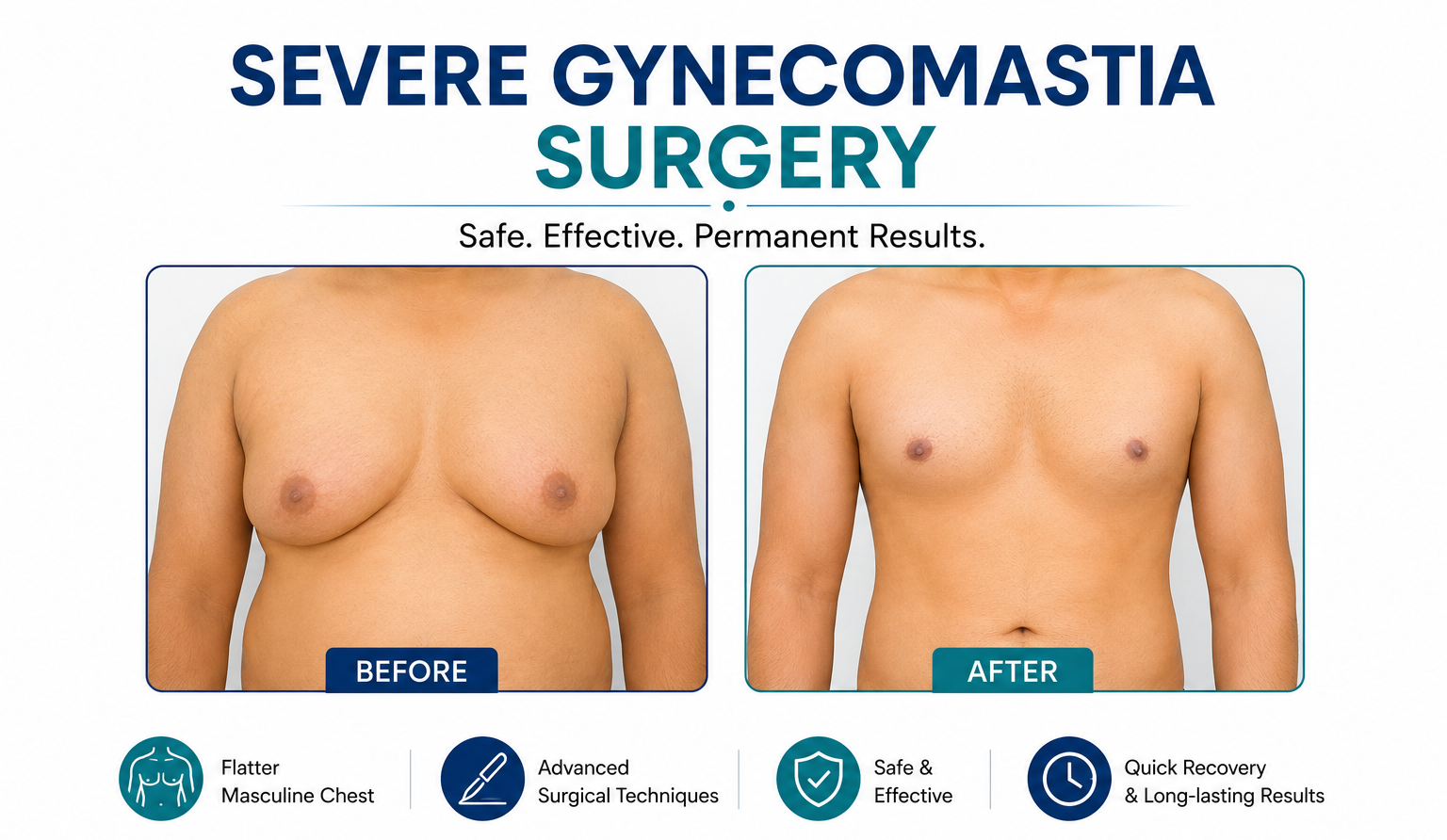
A very large male chest with a hanging fold may need more than liposuction. Significant loose skin and a low nipple position can require skin removal and nipple repositioning. Surgeons may preserve the nipple on a tissue attachment or use a free nipple graft, depending on anatomy, blood supply, and the planned reduction.
For someone searching for “treatment for severe chest sagging male”, the concern often extends beyond chest size. A hanging fold can affect clothing, exercise, and comfort. Removing volume may leave the skin envelope loose, so the treatment plan must address both.
The main questions are: how much fat and gland need removal, how much skin can retract, and where should the nipple sit afterwards? A smaller incision is useful only when it can achieve an acceptable correction.
How do surgeons grade a large chest with a fold?
Assessment takes place with you standing naturally. The surgeon examines chest volume, skin elasticity, the lower fold, nipple position, and any fullness extending towards the sides or back.
A nipple at or below the chest fold suggests drooping, called ptosis. It raises the possibility that nipple repositioning will be needed, but it does not automatically mean a free graft.
Site types and clinical grades are different
The website’s Type 4, 5 and 6 descriptions should not be confused with Simon or Rohrich grades.
Simon classification describes enlargement and skin excess:
| Simon grade | Description |
|---|---|
| I | Small enlargement without excess skin |
| IIa | Moderate enlargement without excess skin |
| IIb | Moderate enlargement with excess skin |
| III | Marked enlargement with excess skin |
Rohrich classification also considers estimated tissue mass and drooping. Higher grades describe substantial enlargement with increasing ptosis. There is no automatic one-to-one conversion between these systems and the website’s numbered types.
For the website’s descriptions, read Type 5: significant breast roll and Type 6: breast roll with back roll.
The consultation should also establish whether enlargement is predominantly glandular, fatty, or mixed. New unilateral changes, a hard lump, or nipple discharge require medical evaluation before cosmetic planning.
When is liposuction with gland removal still enough?
Liposuction removes fat. Gland excision addresses tissue that cannot be adequately corrected by fat removal alone. Neither necessarily removes a substantial hanging skin envelope.
A skin-preserving approach may be considered when elasticity is favourable, skin excess is limited, and nipple position is acceptable. It may also form part of a staged plan: reduce volume first, then reassess the remaining skin after healing.
For someone describing “chest hanging like breast male”, the important distinction is between fullness stretching the skin and an established, loose fold. The appearance may improve as volume decreases, but the amount of skin retraction varies.
Ask what residual looseness the surgeon expects and whether a second operation might be needed. Avoid treating “minimal scar” as a promise that all loose skin will disappear.
See Is liposuction enough for type 4? for the related treatment discussion.
What does the 448-patient study show?
The published single-centre series identified by PubMed 36866186 examined 448 patients treated using liposuction, gland removal and a nipple–areola lifting plaster technique.
It provides evidence about that centre’s approach, but it does not establish that every severe hanging chest can avoid skin excision. The authors reported complications in 116 patients, or 25.9%, and acknowledged limitations including short follow-up. That figure should not be presented as an individual patient’s predicted risk.
A published technique is an option to assess against your anatomy, rather than a guarantee of scar-free correction.
When is skin excision needed, and where do the scars go?
Skin excision becomes more relevant when the remaining envelope is unlikely to settle into an acceptable contour after volume reduction.
The excess skin chest male concern is particularly important after major weight loss. There may be relatively little tissue left, yet substantial loose skin and a low nipple position.
A practical nipple-to-fold rule is:
- Above the fold: Consider whether skin retraction and tissue reduction can give sufficient correction.
- At the fold: Assess nipple lift requirements and the amount of skin excess.
- Below the fold: Discuss more substantial repositioning, skin removal and the feasibility of preserving nipple blood supply.
This is a planning framework, not a validated home test or an automatic treatment rule.
Decision table: skin, nipple position and surgical options
| Nipple position relative to fold | Skin excess | Technique that may be considered | Possible scar pattern | Sensation trade-off |
|---|---|---|---|---|
| Above fold | Limited | Liposuction with gland removal when required | Small access scars and partial areolar-border scar | Temporary or permanent changes remain possible |
| Near fold | Mild to moderate | Selected circumareolar skin reduction | Scar around the areola | Sensation may be preserved but is not guaranteed |
| At or below fold | Substantial | Skin excision with nipple carried on a tissue pedicle | Longer transverse or another tailored reduction pattern | Preserved attachment may help retain sensation |
| Well below fold | Very substantial | Extensive reduction; pedicled repositioning or free graft depending on anatomy | Long chest scars; free graft adds a scar around the relocated areola | Free graft carries greater concern for permanent sensory loss |
These are possible patterns. The surgeon must mark the proposed incisions on your chest before you consent.
Understanding the scar patterns
A partial areolar incision follows part of the border of the darker skin. A circumareolar incision surrounds it. More extensive skin removal may require a transverse scar across the lower chest, sometimes extending towards the sides.
Keeping the scar around the areola limits how much skin can be removed without excessive tension or distortion. Wider correction may therefore require a longer scar.
Discuss scars with your arms relaxed and raised, including how they may appear without a shirt. All surgical scars are permanent, although their visibility can change as they mature.
What is a free nipple graft, and who needs one?
In a pedicled technique, the nipple–areola complex remains attached to tissue carrying its blood supply while it is repositioned.
In a free nipple graft, it is detached and placed onto a prepared area of the reduced chest. The graft must establish a new blood supply from the underlying tissue.
A free nipple graft gynecomastia approach may be considered for very substantial skin excess and drooping when a suitable pedicled correction is difficult. Size alone does not decide it; the movement required, tissue quality, and blood supply also matter.
Trade-offs include reduced or absent sensation, pigment changes, flattening, and partial or complete graft loss. Preserving the nipple on a pedicle may be an alternative in some severe cases.
Ask why grafting is proposed, whether a pedicled option is feasible, and what contour differences each approach may produce.
Which recovery steps and risks are specific to large-chest surgery?
A larger operation creates more skin edges and tissue surfaces to heal. Recovery instructions must match the technique used.
Dressings, drains, and a support garment may be prescribed. If a free graft is used, follow the surgeon’s specific instructions about protecting its dressing and avoiding friction or pressure. Do not remove protective dressings yourself.
Walking, wound checks, and restrictions on lifting should follow the written plan. Returning to desk work does not mean the chest is ready for strenuous exercise.
The American Society of Plastic Surgeons recommends individual instructions covering wound and drain care, medicines, warning signs and follow-up.
Risks to discuss before surgery
These include bleeding or haematoma, fluid collection, infection, delayed healing, skin or nipple tissue loss, asymmetry, contour irregularities and unfavourable scars. Sensory changes may be temporary or permanent.
Report rapid swelling, significant bleeding, fever, spreading redness, worsening pain or a concerning change in nipple colour promptly. Sudden breathlessness or chest pain needs emergency assessment.
Before booking, explain nicotine use, medical conditions, and all medicines. Do not stop prescribed medication without instructions.
What should you ask about grade 3 gynecomastia surgery in Mumbai?
Ask which grading system the clinician uses and how it relates to your skin excess and nipple position. Request an explanation of the proposed incision, likely residual looseness, and reasons for preserving or grafting the nipple.
At Elegance Clinic, discuss the correction you want alongside the scars and recovery you can accept. Dr. Ashutosh Shah’s published profile describes more than 22 years of surgical experience; your examination should establish which options suit your chest.
Read about Severe gynecomastia surgery before discussing the proposed plan.
For chest reduction male cost, request a written quote explaining whether it includes skin excision, nipple repositioning, anaesthesia, garments and follow-up. Clarify potential charges for additional treatment.
Key Takeaways
- Severe sagging requires assessment of tissue, skin, and nipple position.
- Website Type 4–6 labels differ from Simon and Rohrich grades.
- Liposuction may reduce volume without correcting substantial loose skin.
- Pedicled nipple lifting and free grafting have different trade-offs.
- Agree on incision placement and realistic expectations before surgery.