
.png)
Gynecomastia or Just Chest Fat? How to Tell the Difference, and Why Exercise Won't Fix It
Written by Dr. Ashutosh A Shah, M.B.B.S., M.S., M.Ch., D.N.B., Board Certified Plastic Surgeon, Elegance Clinic, Surat. Reg. no. [REG NO]. 22+ years in plastic and cosmetic surgery.
Medically reviewed by Dr. Ashutosh A Shah · Published 21 September 2026 · Last reviewed 21 September 2026
Before considering gynecomastia surgery, know what you actually have. True gynecomastia is firm glandular tissue behind the nipple, while chest fat, called pseudogynecomastia, is soft and even. A pinch test separates them. Exercise and weight loss reduce fat only, so glandular tissue needs surgical removal to go permanently.
Most men who walk into a clinic asking about a "man boob" problem have already spent one or two years in the gym trying to fix it. The chest got firmer. The lump stayed. That is not a training failure, it is a tissue problem, and this post shows you how to tell which tissue you are dealing with before you spend money on anything.
You will get a 60 second self-check, the causes worth ruling out, the grading scale surgeons use, what each grade actually needs, recovery timelines, cost ranges in India, and the questions to ask a surgeon.
How do you know if it is gynecomastia or chest fat?
Pinch the tissue directly under and around the nipple between your thumb and forefinger. True gynecomastia feels like a firm, rubbery, clearly bordered disc sitting right behind the areola, and it is often tender. Chest fat feels soft, even and spread across the whole chest with no distinct edge.
Gynecomastia is the growth of actual male breast gland tissue. Pseudogynecomastia is fat deposition in the chest with no gland growth at all. The two look similar in a t-shirt and behave completely differently.
Do the check standing in front of a mirror, then lying flat. Glandular tissue keeps its shape and stays palpable when you lie down. Fat flattens and spreads out. That single difference is the most useful thing a man can learn about his own chest.
| What you are checking | True gynecomastia (gland) | Pseudogynecomastia (fat) |
|---|---|---|
| Feel on pinching | Firm, rubbery, sometimes hard | Soft, doughy, compressible |
| Location | Concentrated directly behind the areola | Spread evenly across the chest |
| Border | Distinct disc you can trace with a finger | No clear edge, blends into the chest wall |
| Tenderness | Often tender or sore, especially early on | Usually not tender |
| Nipple appearance | Puffy, pointed or dome shaped areola | Areola usually normal, chest just sags |
| Response to fat loss | Lump remains, can look more obvious | Shrinks along with overall body fat |
| Lying flat | Disc still palpable and holds shape | Flattens and spreads |
A word of caution. A hard, fixed, one-sided lump, a lump away from the nipple, skin dimpling, nipple retraction or any bloody discharge is not a self-check situation. Get it examined promptly, because male breast cancer, though uncommon, presents exactly that way.
What causes true gynecomastia?
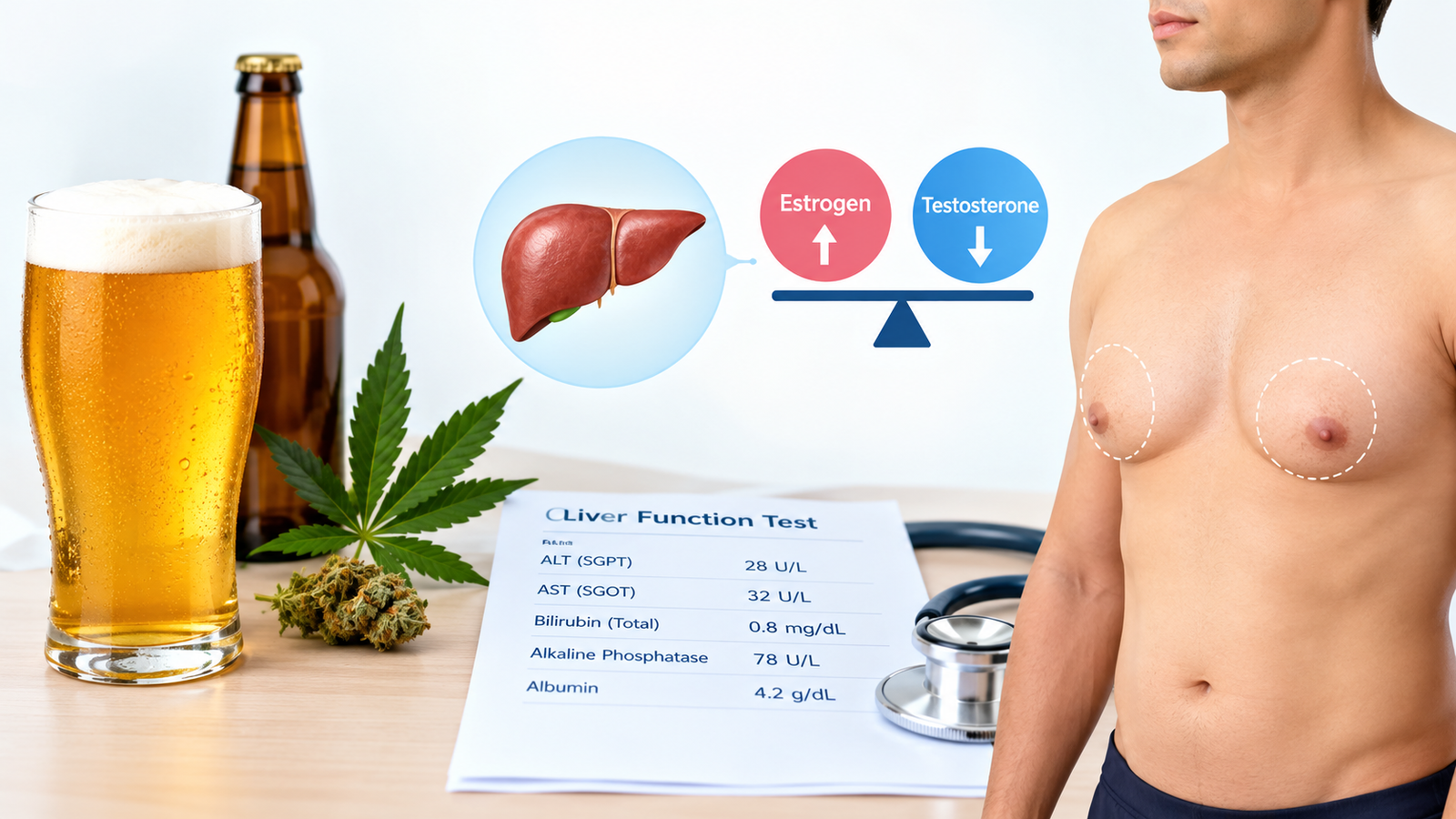
Gynecomastia is driven by an imbalance between estrogen and testosterone activity in breast tissue, not by being overweight. Fat makes it look worse, but the gland grows for hormonal reasons.
The common drivers are:
- Puberty. A large share of teenage boys develop some breast tissue, and most of it settles on its own within six months to two years.
- Newborn and older age hormone shifts. Maternal estrogen in infancy, and falling testosterone with rising body fat after roughly 50.
- Anabolic steroids and testosterone misuse. A very frequent cause in gym-going men in their twenties and thirties. Excess testosterone converts to estrogen.
- Medication. Anti-androgens, some antidepressants, certain heart and blood pressure drugs, some antibiotics, and acid-reflux medication have all been linked to it.
- Alcohol and cannabis. Both are recognised contributors.
- Liver, kidney and thyroid disease. These alter hormone clearance and balance.
- Hypogonadism and, rarely, hormone-secreting tumours. Worth excluding when onset is rapid or one-sided.
Public health bodies including Mayo Clinic and the NHS list the same hormonal, medication-related and lifestyle triggers. That matters practically: if a drug or a steroid cycle is the cause and the gland is still new and tender, stopping it early can sometimes reverse things without surgery.
A full list of presentations is set out on our gynecomastia types page.
Why won't exercise or weight loss fix gynecomastia?
Exercise and dieting reduce fat cells. They have no mechanism to remove glandular breast tissue, because gland is not an energy store the body burns. That is the entire reason chest workouts fail.
Fat is metabolically active tissue held as fuel, so a calorie deficit shrinks it. Breast gland is fibrous, hormone-responsive tissue that stays put regardless of your body fat percentage. Bench press and push-ups build pectoralis muscle underneath the gland, which pushes the disc forward and, in several patients, makes the chest look worse after months of training.
In our practice in Surat we regularly see lean, seriously fit men with visible body definition who still have a firm disc under each nipple. Their body fat is single digit. The gland has not moved. It is the clearest demonstration that this is not a discipline problem.
There is one exception worth stating honestly. If what you have is genuinely pseudogynecomastia, meaning fat only, then sustained fat loss does work and no operation is needed. That is exactly why the self-check above comes before any talk of treatment.
What are the grades of gynecomastia and what does each one need?
Surgeons grade gynecomastia by how much tissue is present and how much loose skin comes with it, because those two things decide the operation. Most Indian practices work from Simon's classification, extended by the Rohrich system for severe drooping, with pseudogynecomastia sitting outside the scale.
| Level | What it looks like | Usual treatment approach |
|---|---|---|
| Pseudogynecomastia | Fat only, no gland disc, no puffy areola | Fat loss first; liposuction if it persists at a stable weight |
| Grade 1 | Small button of gland, puffy nipple, no skin excess | Gland excision through a small areolar incision, often with limited liposuction |
| Grade 2a | Moderate enlargement, chest contour affected, skin still tight | Liposuction plus gland excision, skin retracts on its own |
| Grade 2b | Moderate enlargement with early skin excess at the lower border | Liposuction plus excision, sometimes with minor skin tightening |
| Grade 3 | Marked enlargement with clear skin excess, breast-like shape | Excision plus planned skin reduction, areola often resized |
| Grade 4 (Rohrich) | Severe enlargement with significant drooping, nipple below the fold | Formal male chest reduction with skin excision and nipple repositioning |
Two practical points follow from this table. First, liposuction alone is never enough once a gland disc is present, no matter how skilled the operator. Second, the higher the grade, the more the result depends on skin planning rather than on how much tissue is pulled out.
What does gynecomastia surgery actually involve?
Gynecomastia surgery removes the glandular disc through a small incision along the lower edge of the areola, usually combined with liposuction to blend the chest contour. It is most often a day-care procedure under general or local anaesthesia with sedation, taking roughly 60 to 120 minutes for both sides.
The sequence is straightforward:
- Marking. You are marked standing up, because the chest changes shape when you lie down.
- Liposuction. The fatty layer around and over the gland is reduced first to define the contour and feather the edges into the chest wall.
- Gland excision. The firm disc is removed through the areolar incision. A thin cushion of tissue is deliberately left under the nipple to avoid a sunken, saucer-like crater.
- Skin management. In lower grades the skin is left to retract. In higher grades excess skin is removed and the areola is resized or repositioned.
- Compression. A compression vest goes on at the end and does a lot of the shaping work over the next few weeks.
Typical recovery: desk work in 3 to 5 days, compression vest for 4 to 6 weeks, light cardio around 2 to 3 weeks, chest and upper-body training at 6 to 8 weeks. Swelling settles gradually and the final contour is usually judged at 3 to 6 months. Scars sit at the areolar border and fade considerably over the first year.
Details of the technique and anaesthesia options are covered on our gynecomastia surgery page, and real patient contours are shown in the before and after gallery.
Can gynecomastia come back after surgery?
Once the glandular disc is properly excised it does not grow back, because the tissue is gone. What can come back is fat, and that is the usual reason a man thinks his gynecomastia has returned.
Genuine recurrence is uncommon and generally has one of three explanations: the gland was incompletely removed the first time, a new steroid or testosterone cycle was started, or an untreated hormonal or liver condition is still driving tissue growth. Significant weight gain can also re-fill the fatty layer and blur a good contour.
Stay off unsupervised anabolic steroids, keep your weight reasonably stable, and treat any underlying endocrine problem. Those three things protect the result far more than anything done in the operating room.
What is the cost of gynecomastia surgery in India?
In India, gynecomastia surgery is commonly quoted in the range of about ₹40,000 to ₹1,50,000 for both sides. Price is driven mainly by the grade, whether skin excision is needed, the anaesthesia type, and the hospital or day-care facility used, not by the city alone.
What a written quote should include:
- Surgeon's fee and assistant fee
- Anaesthetist's fee and the anaesthesia type being planned
- Operating theatre and day-care or room charges
- Pre-operative blood tests, hormone profile and any imaging
- The compression vest
- Medication, dressings and all follow-up visits
- Whether GST is included, and the policy if a touch-up is ever needed
Be careful with very low advertised prices. They usually cover liposuction only, which leaves the gland behind and guarantees a second procedure. Insurance in India rarely covers gynecomastia unless there is documented pain, a proven underlying disease or significant functional impact, so ask before you assume.
How do you choose a surgeon for gynecomastia surgery?
Choose a qualified plastic surgeon with an M.Ch. or D.N.B. in plastic surgery who performs this operation regularly and can show you their own before and after results at your grade. Qualification and case volume matter more than clinic decor or discount offers.
Questions worth asking at the consultation:
- What grade am I, and how did you assess it?
- Will you excise the gland, or is this liposuction only?
- Where exactly will the scar sit and how long will it take to fade?
- Can I see results of your own patients with a chest like mine?
- How do you avoid a crater or saucer deformity under the nipple?
- Will skin excision be needed, now or later?
- Who administers the anaesthesia, and where is the procedure done?
- What is included in the quote, and what happens if a revision is required?
Gynecomastia surgery at Elegance Clinic, Surat
Dr. Ashutosh A Shah is a board certified plastic surgeon with over 22 years of practice in Surat, Gujarat, and male chest contouring is a routine part of that work. Every consultation starts with the same examination described above, because grading the chest correctly is what decides whether you need fat loss advice, liposuction, gland excision or a full skin-reduction plan. Men are told plainly when surgery is not the right answer yet.
Common questions from patients in Surat and across Gujarat are answered on our gynecomastia FAQs page.
Next step
If the pinch test suggests a firm disc rather than soft fat, a 10 minute examination will tell you your grade and what it actually needs. Book an appointment with Dr. Ashutosh Shah at Elegance Clinic, Surat, or call +91 83205 00350.
Medical disclaimer: This article is for education only and is not a substitute for professional diagnosis or treatment. Please consult Dr. Ashutosh A Shah or a qualified plastic surgeon about your own chest before making any treatment decision.